Most people Googling this want the same thing: send form responses straight into a spreadsheet so they stop downloading CSVs.
The path is six clicks inside Google Forms, no add-on, no script, no Apps Script Editor. Open the Responses tab, click Link to Sheets, then pick "Create a new spreadsheet" or "Select existing spreadsheet" in the dialog that opens. Every new submission lands as a fresh row.
This guide walks the full setup with screenshots, fixes the four things that break it (responses not appearing, formulas erasing on submit, an existing sheet that won't link, unlinking gone wrong), and covers the reverse direction most blogs skip: how to pre-fill a Google Form from a Google Sheet.
At the end, Formester's Google Sheets integration lets you skip the spreadsheet entirely (live dashboards, automated emails, branded forms) if response analytics is what you actually want.
Watch the Google Forms to Google Sheets link in real time
The video walks the green Sheets icon flow, the “Select existing spreadsheet” option most blogs skip, and where Formester’s Google Sheets integration takes over for branded forms and dashboards.
Step 1: Open or Create Your Google Form
Open Google Forms and either click "Blank form" to start fresh or open the form you already built.
The link to a Sheet is identical for both. Add or check your questions, your titles, your sections.
You can change the form structure later; the Sheet picks up new columns automatically when you do.
Step 2: Open the Responses Tab
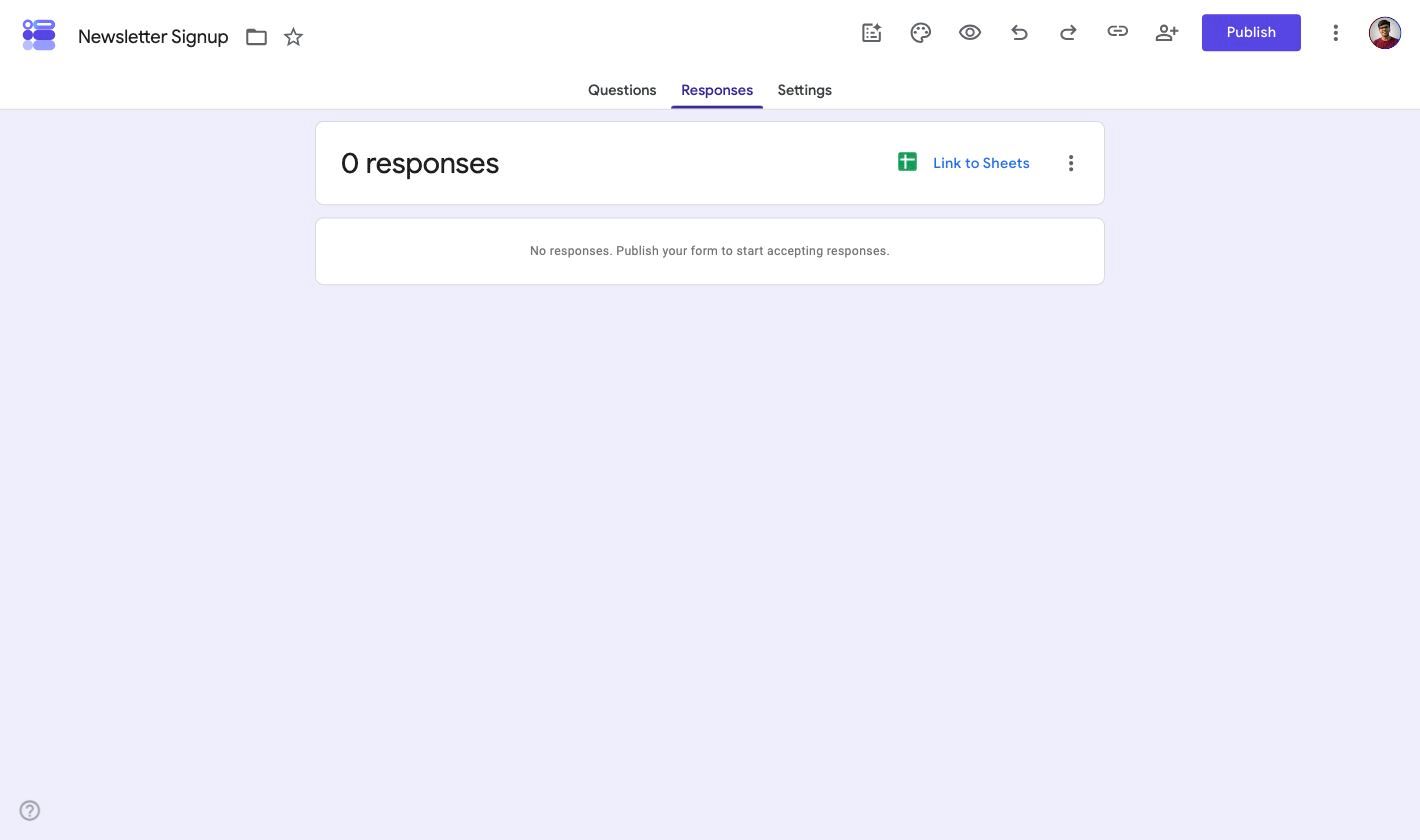
After creating your form, you'll need to access where the responses will be stored:
- Click on the Responses Tab: At the top of your form, click on the “Responses” tab. This is where you’ll manage the collected data.
- Click Link to Sheets: The control sits to the right of the response count, with the green Sheets glyph beside it. This icon will link your form to a Google Sheet.
Step 3: Pick a New Sheet or an Existing One
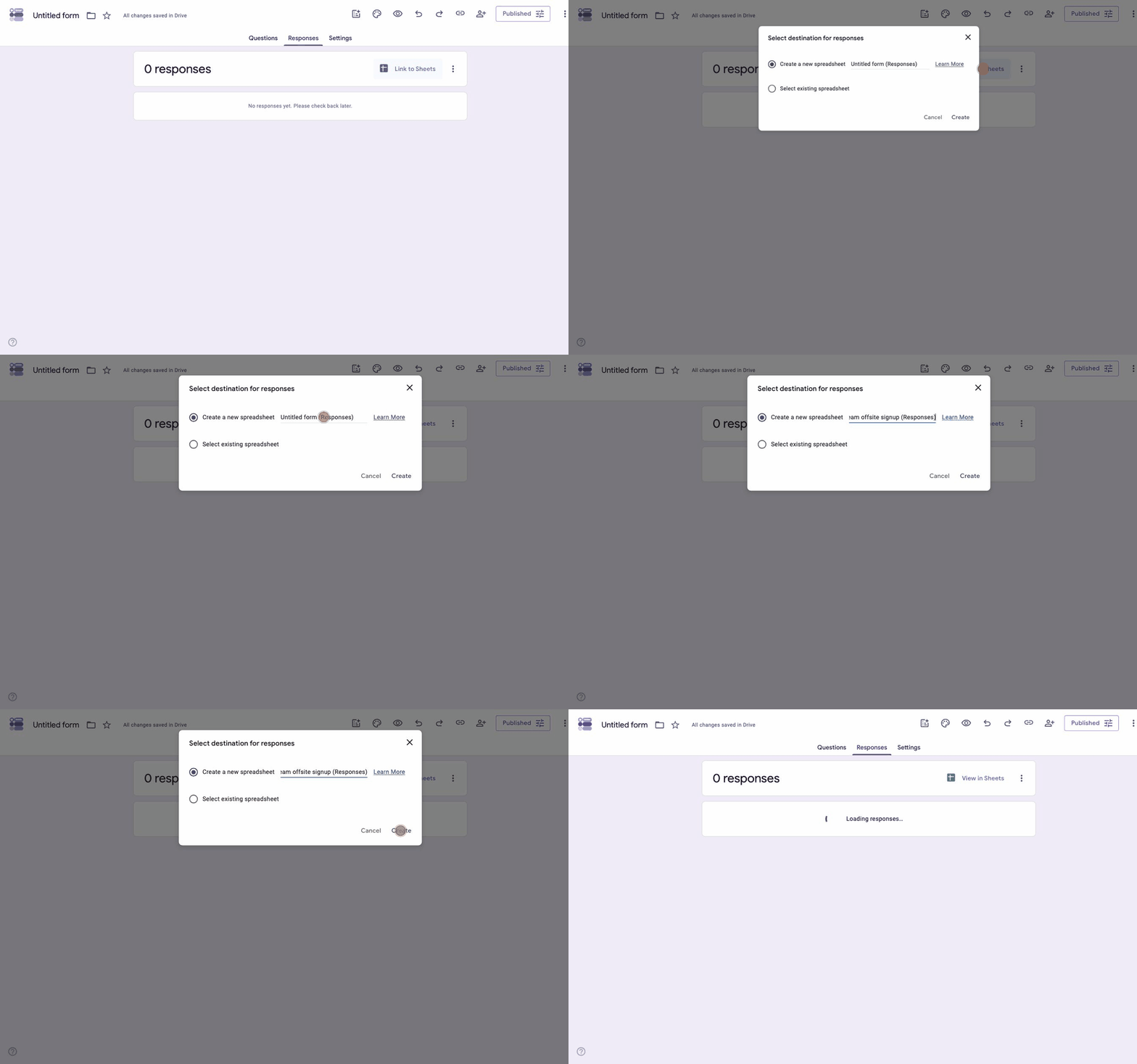
Now, you’ll choose where to store your form responses:
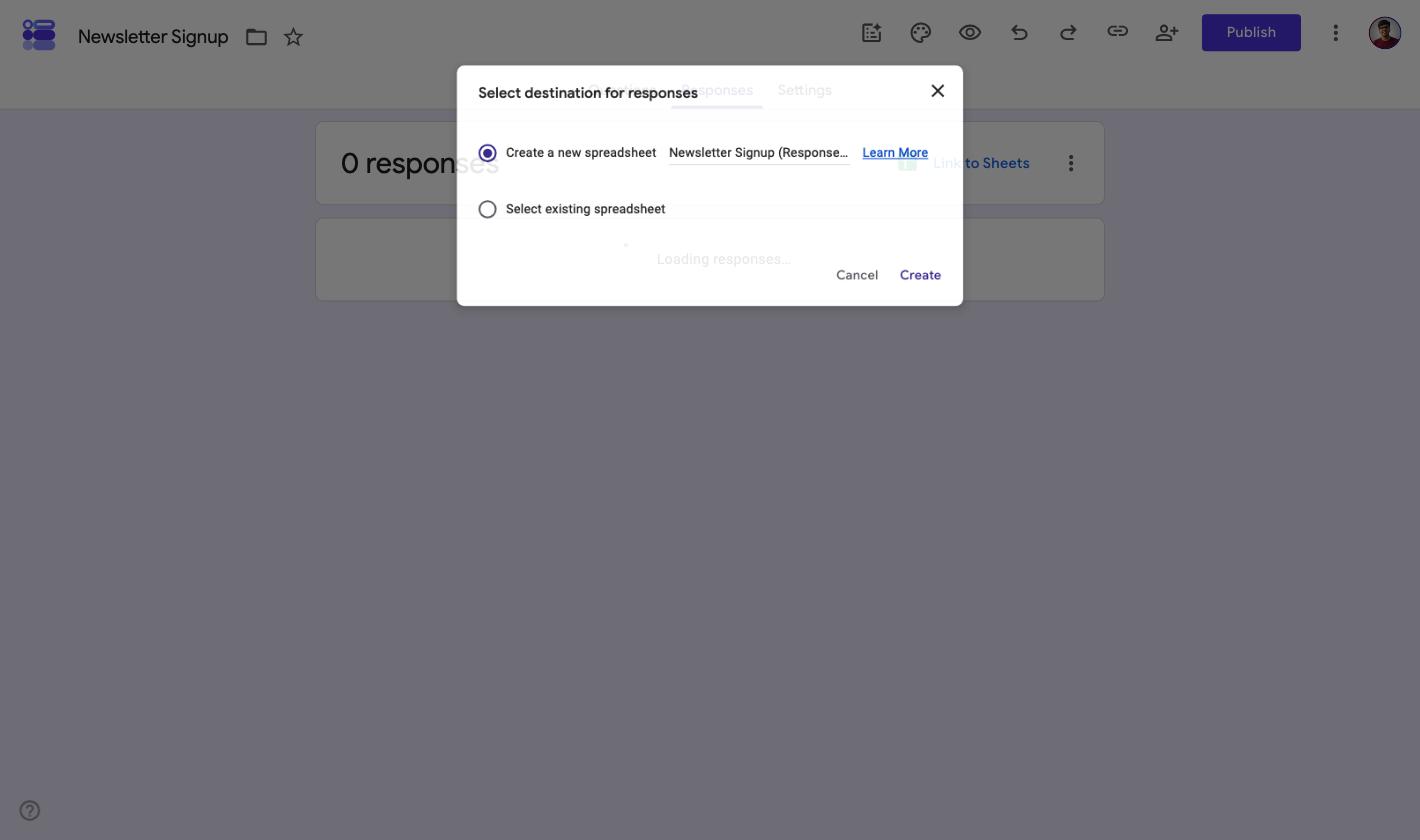
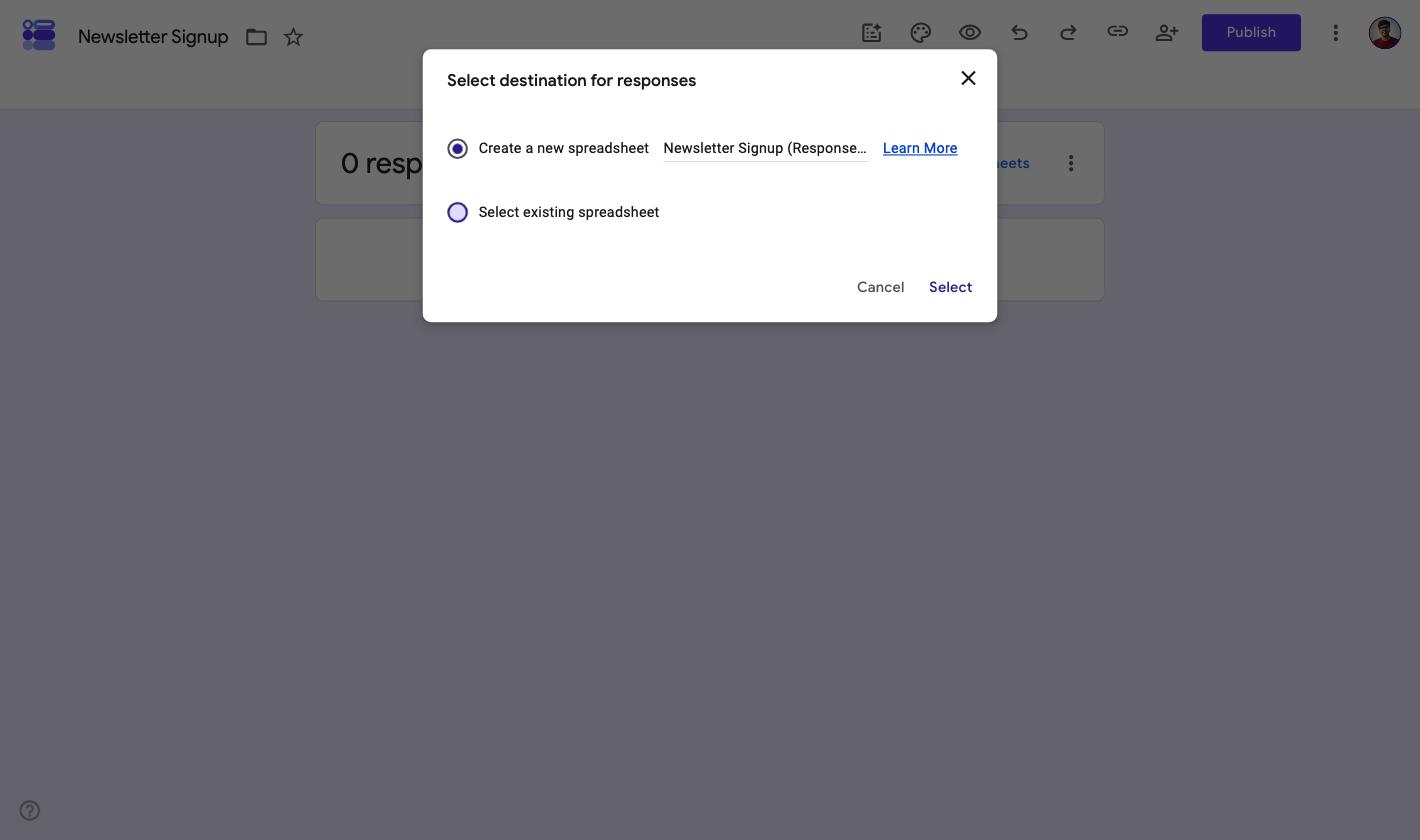
- Create a New Spreadsheet: A dialog titled Select destination for responses opens with Create a new spreadsheet already selected. Select “Create a new spreadsheet” to generate a new Google Sheet specifically for your Google Form responses.
- Choose an Existing Spreadsheet: If you prefer to use an existing spreadsheet, select “Select existing spreadsheet.” Navigate to the desired spreadsheet and click “Select.”
Step 4: Submit a Test Response
Open your form in preview (the eye icon top-right), fill in any answers, hit Submit. Switch back to the Sheet tab. The new row should appear within 2-3 seconds.
If it doesn't, jump to the troubleshooting section below. Nine times out of ten it's the wrong tab, the wrong form, or a sheet that was renamed after linking.
Step 5: Customize the Sheet Without Breaking the Link
You can format, sort, filter, and color the Form Responses tab freely. What you cannot do without consequences:
Delete the Form Responses tab. This unlinks the form. New responses start a fresh tab.
Rename column headers. Google rewrites them on the next submission and your formulas break.
Insert formulas inside the response columns. Each new row pushes existing rows down; in-row formulas often get erased on submit (Stack Exchange has the canonical thread). Put formulas in a separate tab and reference the response tab with
=QUERY('Form Responses 1'!A:Z, "select *", 1)or similar.
For analysis, the safe pattern: keep the response tab untouched, build pivots and charts in a second tab that reads from it.
Step 6: Share the Sheet (Not the Form)
Finally, share your data with your team or stakeholders:
Share the Google Sheet: Click the “Share” button in your Google Sheet. Enter email addresses and set permissions to share the sheet.
Collaborate in Real-Time: Use Google Sheets’ collaboration features to work with others in real-time. Edit, comment, and review responses together.
Why Your Responses Are Not Showing Up in the Sheet
The connection almost never breaks on its own. Four things account for nearly every case.
- The response tab was renamed or deleted. Google writes to the tab it created. Rename it and new rows still arrive, but any formula pointing at the old name breaks. Delete it and the form makes a fresh one, leaving old responses stranded in the trash.
- You are looking at the wrong spreadsheet. If the form was ever relinked, older responses stayed in the first sheet. Check the Responses tab, then Link to Sheets, to see which file it writes to now.
- A column was inserted inside the response range. Google appends by column order, so an inserted column shifts answers into the wrong headers from that point on.
- Responses were collected before the sheet existed. Linking does backfill existing responses, but only into the tab it creates at that moment. If you deleted that tab, the backfill is gone with it.
To re-establish a clean link, unlink the current sheet from the Responses tab, then link again and let Google create a new tab. If what you actually need is a fixed copy of each response rather than a live sheet, saving the form as a PDF is a different route.
How to Link Google Sheets to Formester
Google's native sync is fine for low-volume internal forms. If you are weighing other options, we compare form builders that work with Google Sheets separately. It cracks at three points: branding (every form looks the same), analytics (Sheets needs manual pivots), and conditional logic (Google Forms' branching is section-based and clunky).
Formester's Google Sheets integration keeps the same auto-sync flow (every submission becomes a new row, no Zapier needed) and adds:
Branded forms. Your logo, colors, fonts, custom domain. No "Powered by Google."
Live dashboards. Form analytics show drop-off rate, completion rate, and per-question performance inside Formester itself. You still get the Sheet; you also get a dashboard you don't have to build.
Conditional logic that branches per-question instead of per-section.
File uploads with 1GB caps on Personal, 50GB on Business (Google caps at 1GB per response and stores files in Drive, which fills fast).
API + webhooks + Zapier + n8n if Sheets is one of many destinations, not the only one.
How to connect:
Sign up at formester.com (free plan includes unlimited forms and responses).
Build the form in the drag-and-drop editor.
Open Settings → Integrations → Google Sheets. Authorize. Pick a new sheet or an existing one.
Publish the form. Every submission lands in the Sheet and in the Formester dashboard.
Try the Google Sheets integration
Google Forms green-icon sync, or Formester’s Google Sheets integration
Internal form, low volume, no branding needed? Stick with native. Customer-facing forms that need branding, analytics, or pre-fill logic? Formester pulls ahead.
| Capability | Google Forms + Sheets (native) | Formester + Google Sheets |
|---|---|---|
| Auto-sync to a Sheet | Yes (green icon, one-click) | Yes (Settings → Integrations → Google Sheets) |
| Branded forms (logo, colors, custom domain) | No | Yes (Personal plan and up) |
| Built-in analytics dashboard | No (build pivots in Sheets manually) | Yes (form analytics) |
| Per-question conditional logic | Section-based only | Per-question (conditional logic) |
| File uploads | 1GB per response, files in Drive | 100MB Free / 1GB Personal / 50GB Business (file uploads) |
| Pre-fill from a Sheet on load | No (manual prefilled link only) | Yes (auto-fill from external data) |
| Webhooks + API | No | Yes |
| Free tier | Unlimited responses (Google account) | Unlimited forms and responses |
Google Forms is fine for response collection. Formester’s Google Sheets integration pulls ahead when you need pre-fill from a sheet, branded forms, multi-form aggregation, or a dashboard you don’t have to build by hand.
In Summary
Google Forms to Google Sheets integration and Formester simplifies data collection and management. Linking Google Sheets to Google Forms can streamline data collection and analysis, making your work more efficient.
These Google Sheets Google Forms integrations simplify workflows and improve productivity. By following these straightforward steps, you can ensure your form responses are automatically organized and ready for analysis. Start linking your forms and sheets today to make your data work for you efficiently.
More from Formester on Google Forms and Sheets
Product pages, integrations, and Google Forms guides that pair with this walkthrough.