How we verified this: every figure on this page comes from the vendor's own pricing page or its public G2 profile. You can check every source here.
Which Wufoo alternative should you choose?
Wufoo has been around for nearly twenty years, and that shows in both directions. It is stable and predictable, and it is also metered at 100 entries a month free with a $0.05 charge for every entry over the limit on paid plans.
Most people leaving want one of three things and it is worth knowing which: more entries, a modern editor, or AI generation. The list below is ordered on that basis.
The 60-second TL;DR
- Best overall alternative: Formester, unlimited responses on the free plan
- Best for template depth and HIPAA: Jotform, from $39/mo
- Best modern editor: Fillout, unlimited seats and 1,000 free responses
- Closest like-for-like swap: Cognito Forms, from $24/mo
- Best AI-first option: forms.app
- Best free plan: Tally, unlimited forms and submissions
- Best for WordPress: Gravity Forms, from $59/year
- Best for enterprise research: Alchemer, from $55/user/mo
Formester vs Wufoo at a glance
The comparison comes down to metering. Wufoo counts entries on every plan and bills for overage; Formester counts nothing and has no overage to bill.
| Formester | Wufoo | |
|---|---|---|
| Free plan | Unlimited forms and responses | 5 forms, 100 entries/mo |
| First paid plan | $13/mo ($12 billed yearly) | $22/mo ($16.25 billed yearly) |
| Entry limits | None on any plan | 1,000 to 200,000 by tier |
| Overage charges | None | $0.05 per entry over the limit |
| AI form generation | On the free plan | Not offered |
| Payments | Stripe and PayPal on free | On paid plans |
| Offline forms | Included | Not offered |
| File upload cap | No cap on the free plan | 25 MB on lower tiers |
| Top tier | $49/mo | $286/mo (Ultimate) |
| G2 rating | 4.7/5 (14 reviews) | 4.2/5 (296 reviews) |
How we picked these
Every figure here comes from the vendor's own pricing page and plan limits, read in full. Each tool had to answer one question: what does it do that Wufoo does not?
Tools that remove the entry ceiling rank highest, then those that modernise the editing experience. Several vendors advertise annual rates, so the monthly figures below run higher than the ones on their pricing pages.
1. Formester, the strongest overall Wufoo alternative
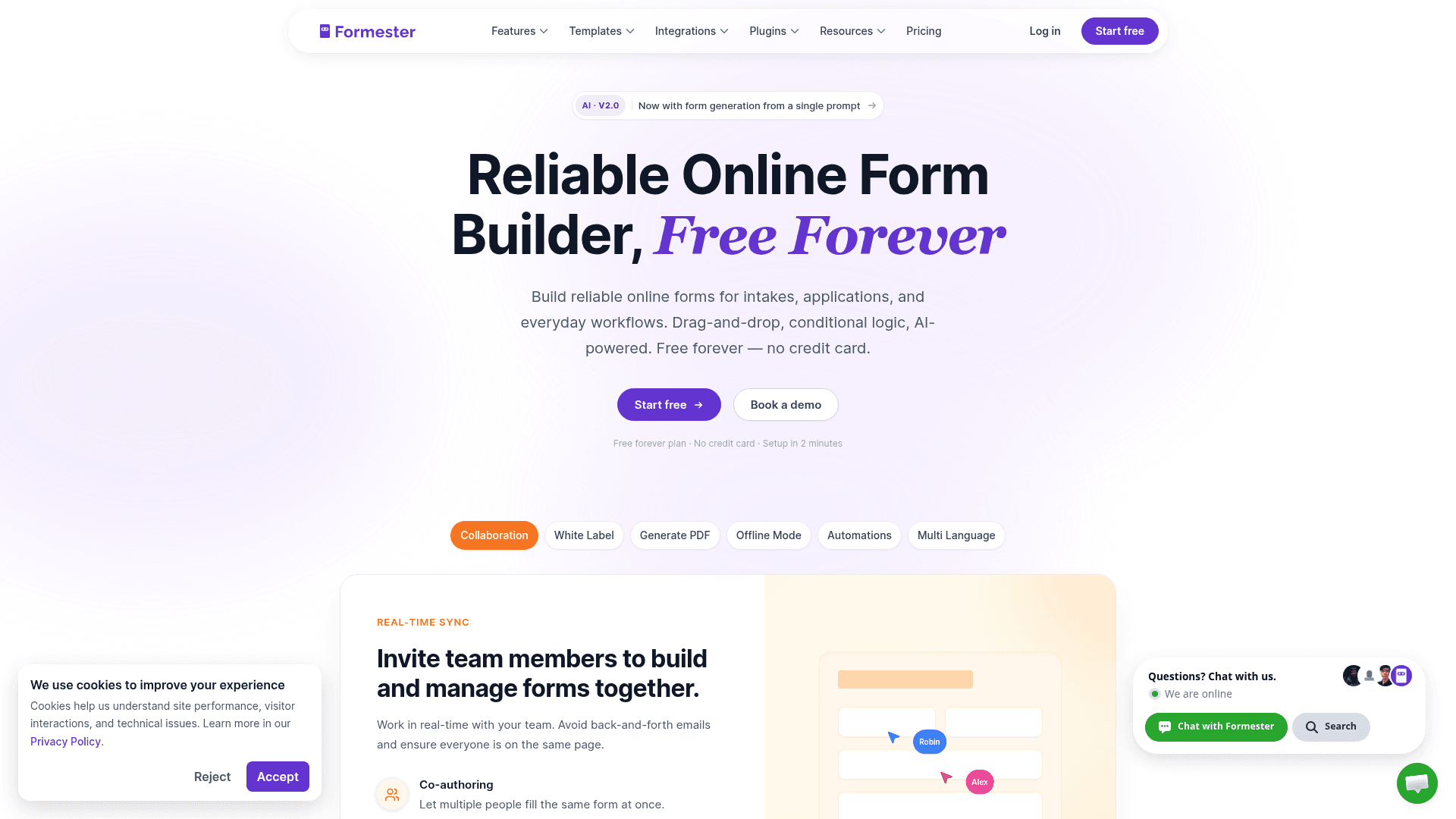
Formester removes both things that push people off Wufoo: the entry cap and the overage charge. Nothing is metered on any plan, so a traffic spike costs nothing extra.
It also adds what Wufoo has never had, namely AI form generation from a prompt or a PDF, offline capture for field work, and drop-off analytics.
Payments run through Stripe and PayPal on the free plan, where Wufoo puts them behind a paid tier. Conditional logic sits on Personal at $13 a month.
| Strengths | Weaknesses |
|---|---|
| No entry cap and no overage charge | Formester branding stays until Personal |
| AI generation from a prompt or a PDF | Conditional logic starts on the paid plan |
| Payments and e-signature on the free plan | 720 templates against Jotform's 20,000 |
| Offline capture for field work | 14 G2 reviews, a small sample |
| Top tier is $49/mo against Wufoo's $286 |
| Plan | What you get |
|---|---|
| Free | $0. Unlimited forms, responses and fields, AI generation, payments |
| Personal | $13/mo ($12/mo billed yearly). Adds conditional logic |
| Business | $49/mo ($45/mo billed yearly). Adds custom domain and 25 seats |
Best for: anyone leaving Wufoo because of entry caps or overage charges.
The catch: the template library is smaller than Wufoo's, so if you relied on picking a ready-made form you will build more from scratch.
G2 rating: 4.7/5, from 14 reviews. High score, small sample; read it as an early signal.
2. Jotform, the alternative when HIPAA or template depth matters
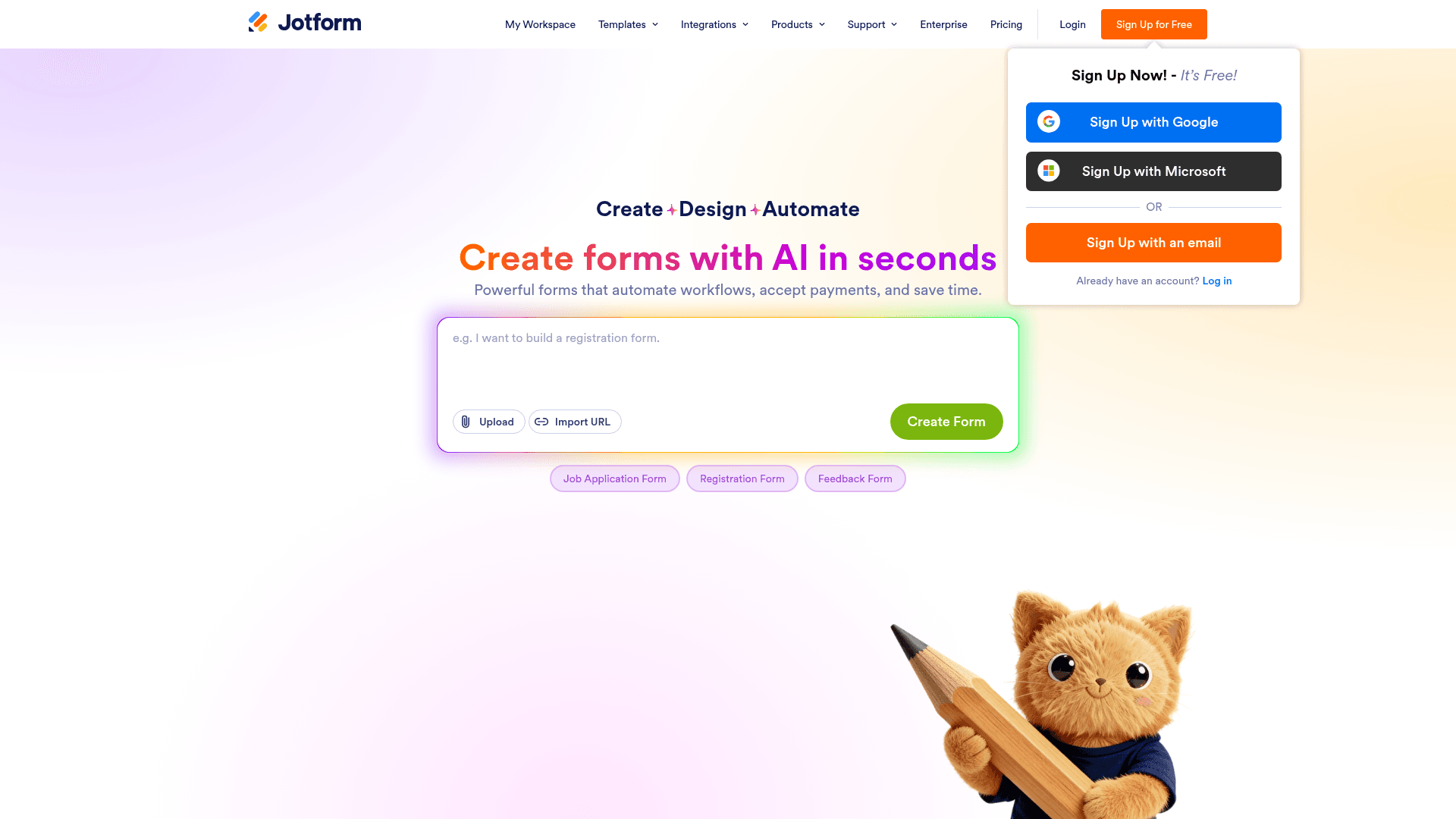
Jotform is the move if what you liked about Wufoo was picking a template and shipping. Its library runs to 20,000+ forms against Wufoo's few hundred.
It also offers HIPAA on Gold at $129 a month, which Wufoo does not provide at any tier, along with 40+ payment gateways.
Submissions are still metered, so you are swapping one cap for another, but there is no per-entry overage charge on top.
| Strengths | Weaknesses |
|---|---|
| 20,000+ templates, the largest library here | Submissions metered on every tier |
| HIPAA on Gold, which Wufoo does not offer | Free plan covers only 5 forms |
| 40+ payment gateways | Dense interface takes time to learn |
| No per-entry overage charges | Advertised prices are the annual rates |
| Plan | What you get |
|---|---|
| Starter (free) | $0. 5 forms, 100 submissions/mo |
| Bronze | $39/mo ($34/mo billed yearly). 1,000 submissions/mo |
| Silver | $49/mo ($39/mo billed yearly). 2,500 submissions/mo |
| Gold | $129/mo ($99/mo billed yearly). 10,000 submissions/mo, HIPAA |
Best for: teams that want a template for everything, or need HIPAA.
The catch: the free plan is no more generous than Wufoo's, so this helps with capability rather than volume.
G2 rating: 4.7/5, from 5,426 reviews, the largest base of any tool here.
3. Fillout, the modern editor with unlimited seats
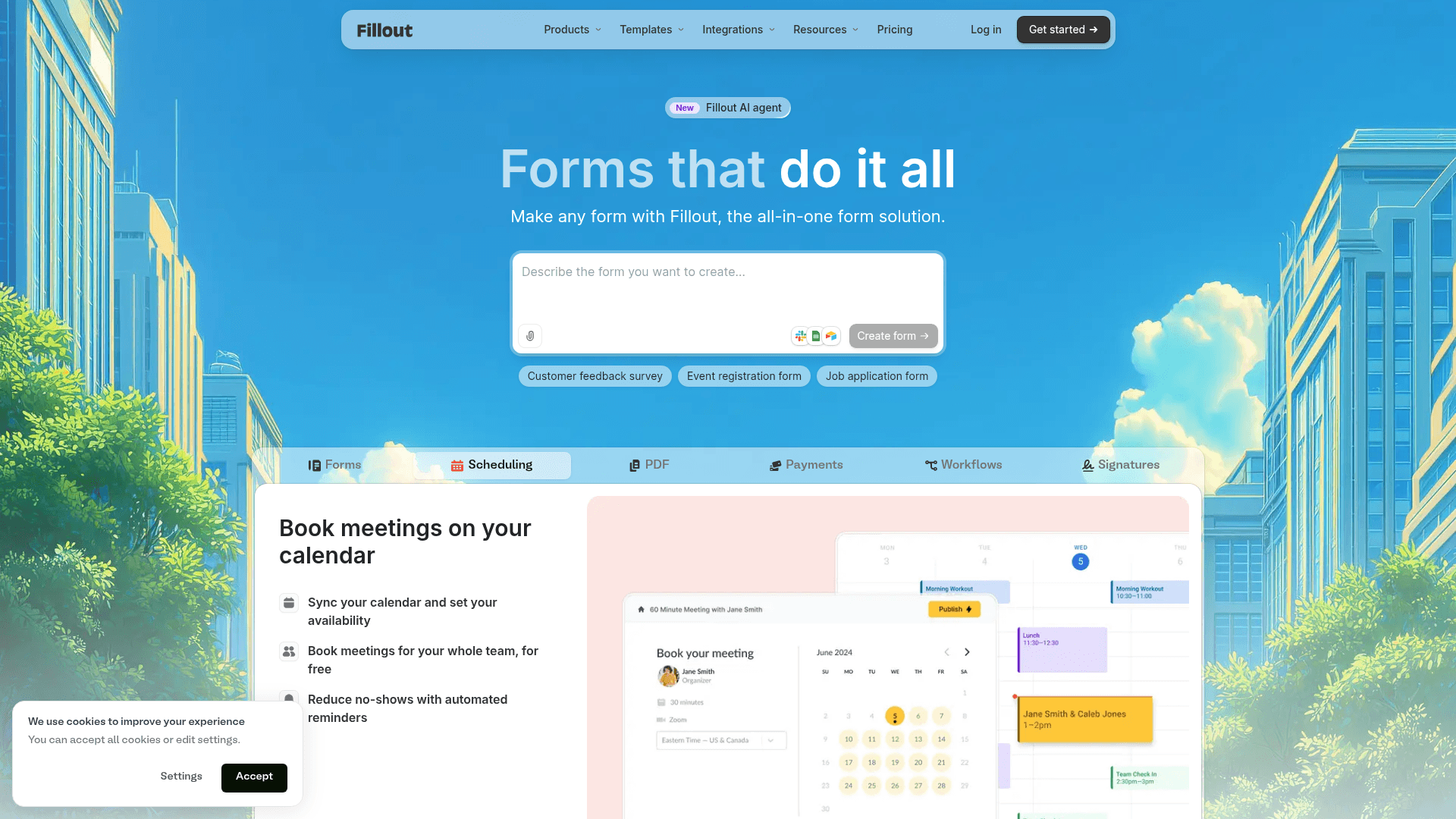
Fillout is the clearest answer to the complaint that Wufoo feels twenty years old. The editor is current, multi-step forms are the default, and the whole thing moves faster.
Its free plan allows 1,000 responses a month against Wufoo's 100 entries, and it puts no limit on seats where Wufoo counts users by tier.
Answers can write into Airtable and Notion records, which is a capability Wufoo has no equivalent for.
| Strengths | Weaknesses |
|---|---|
| 1,000 responses a month free, ten times Wufoo | Most useful only with Airtable or Notion |
| Unlimited seats on every plan | Fillout branding on the free plan |
| Writes into Airtable and Notion records | No HIPAA option |
| Multi-step forms with a progress bar by default | 30 G2 reviews, a small sample |
| Plan | What you get |
|---|---|
| Free | $0. 1,000 responses/mo, unlimited seats |
| Starter | $19/mo ($15/mo billed yearly, $180/year) |
| Pro | $49/mo ($40/mo billed yearly, $480/year) |
| Business | $89/mo ($75/mo billed yearly, $900/year) |
Best for: teams that want a current editor and room to collaborate.
The catch: the database write-back is its real differentiator, so outside Airtable and Notion it is good rather than distinctive.
G2 rating: 4.6/5, from 30 reviews. A small base, consistent with a newer product.
4. Cognito Forms, the closest one-to-one replacement
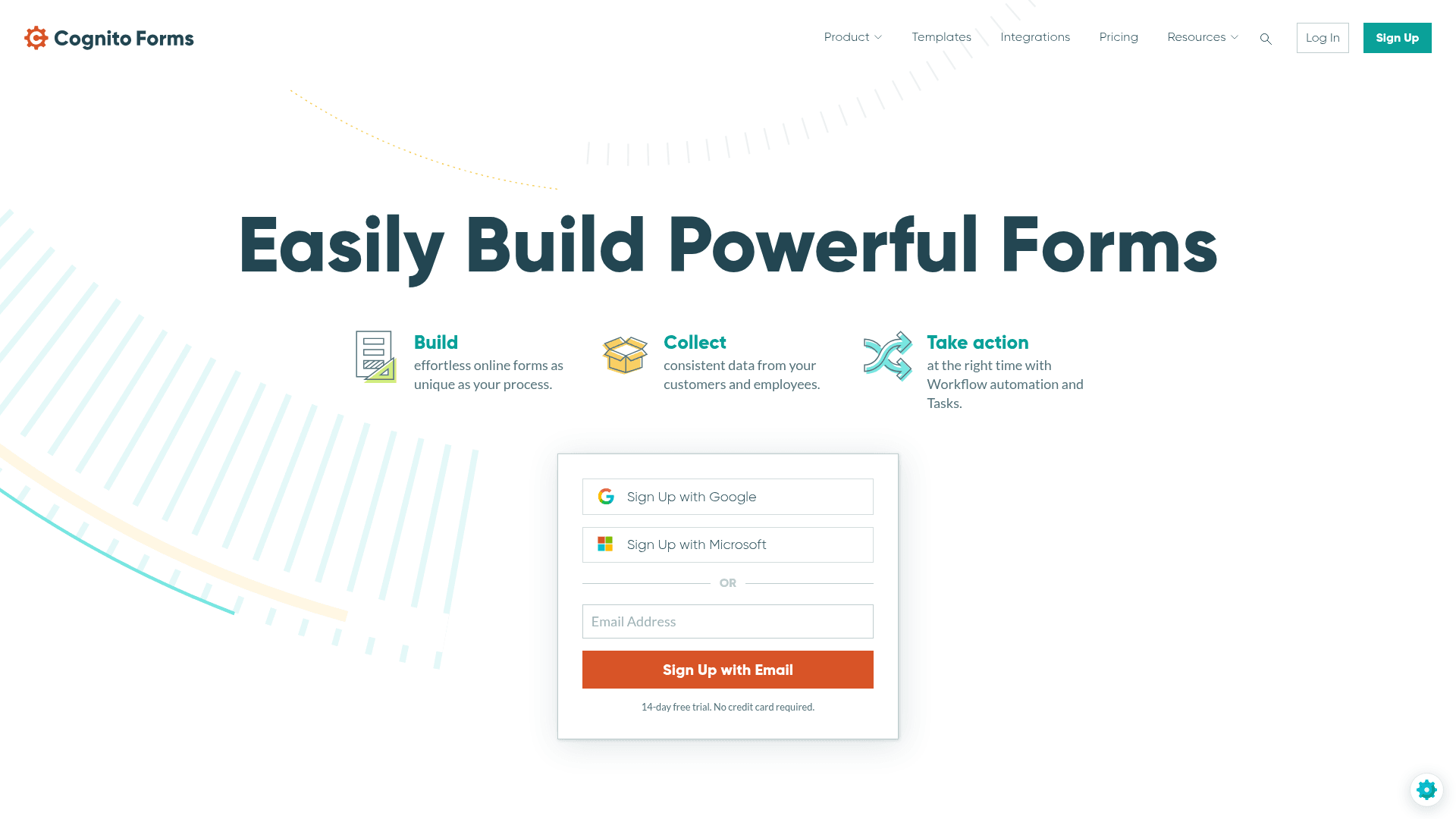
Cognito Forms is the most direct swap. Same idea, same kind of interface, same metering model, but with a calculation engine that goes considerably further than Wufoo's.
Its free plan allows 100 entries a month, matching Wufoo exactly, so volume is not what you gain here.
What you gain is logic. Conditional branching, repeating sections and calculated fields are all on the free plan, where Wufoo offers only basic rules.
| Strengths | Weaknesses |
|---|---|
| Strongest calculation engine in this category | Free plan matches Wufoo at 100 entries |
| Conditional logic and repeating sections free | Entries metered on every tier |
| Payments on the free plan | No AI form generation |
| HIPAA available on Enterprise | Advertised prices are the annual rates |
| Plan | What you get |
|---|---|
| Individual (free) | $0. 100 entries/mo, conditional logic, payments |
| Pro | $24/mo ($19/mo billed yearly). 2,000 entries/mo, 2 users |
| Team | $49/mo ($39/mo billed yearly). 10,000 entries/mo, 5 users |
| Enterprise | $174/mo ($129/mo billed yearly). Unlimited entries, HIPAA |
Best for: people who want Wufoo with real logic behind it.
The catch: the entry cap is the same one you are leaving, so this only makes sense if logic rather than volume is the reason.
G2 rating: 4.6/5, from 133 reviews. A reasonable base with a consistently good score.
5. forms.app, the AI-first alternative
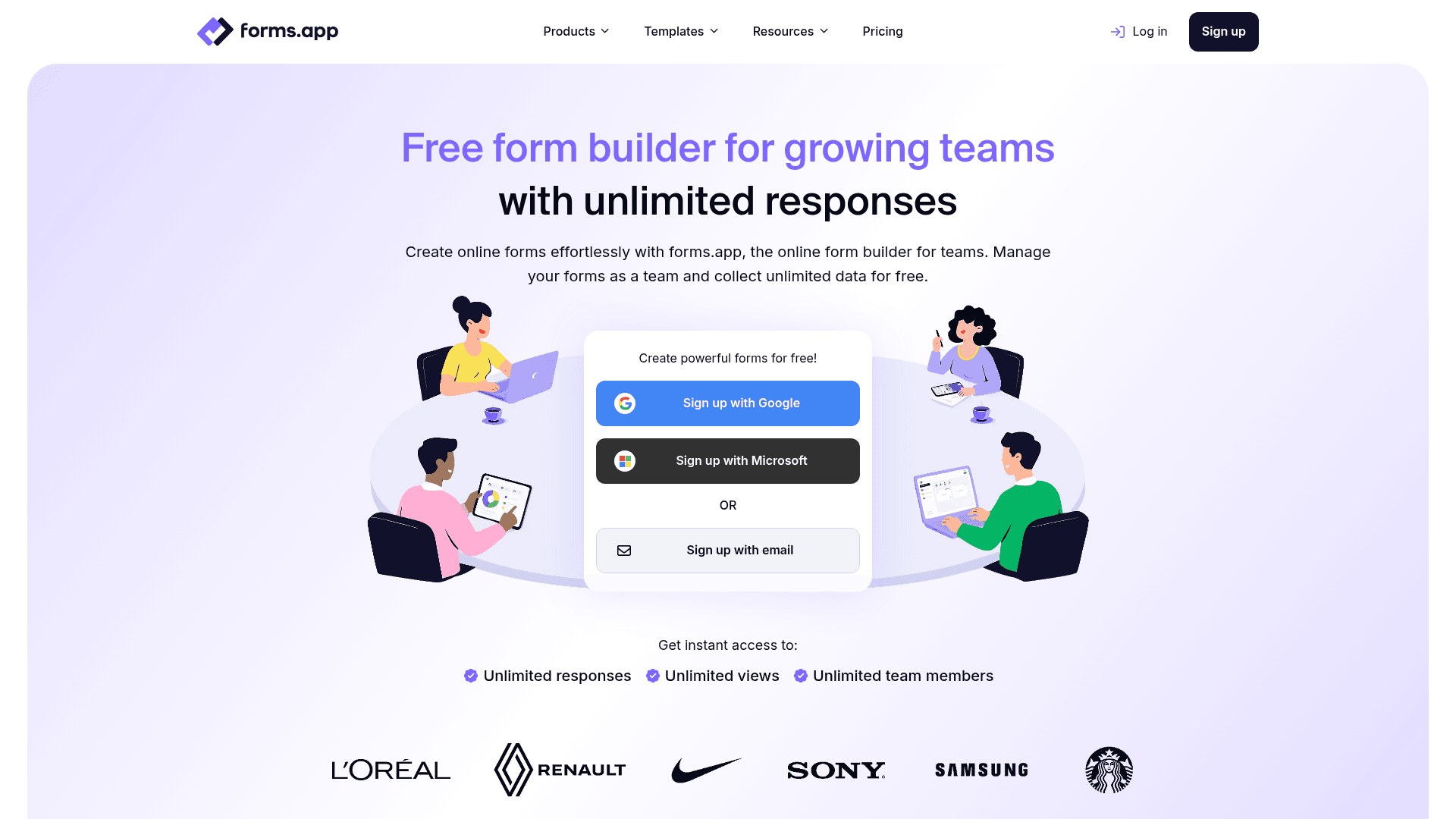
forms.app answers the Wufoo complaint about build time. Describe the form and it drafts one, then you edit rather than assemble fields by hand.
Its free plan inverts Wufoo's model: responses are unlimited but you are capped at 5 forms, which suits a site with a couple of busy forms.
forms.app prices regionally. The US view lists Basic at $19, Pro at $29 and Premium at $59 a month, while the EU view lists 16, 24 and 49 EUR billed annually.
| Strengths | Weaknesses |
|---|---|
| AI generation from a prompt | Free plan caps at 5 forms and 10 MB storage |
| Unlimited responses on the free plan | Pricing varies by region and currency |
| Conditional logic and e-signatures included | Younger product with a shorter track record |
| 5,000+ templates | No HIPAA option |
| Plan | What you get |
|---|---|
| Free | Up to 5 forms, unlimited responses, 10 MB storage |
| Basic | Listed at $19/mo in the US view and 16 EUR/mo billed annually in the EU view |
| Pro | Listed at $29/mo in the US view and 24 EUR/mo billed annually in the EU view |
| Premium | Listed at $59/mo in the US view and 49 EUR/mo billed annually in the EU view |
Best for: sites running a small number of high-traffic forms.
The catch: prices differ by region and currency, so confirm the rate on your own regional pricing page before you budget.
G2 rating: 4.5/5, from 498 reviews. A solid base for a younger product.
6. Paperform, the content-driven form builder
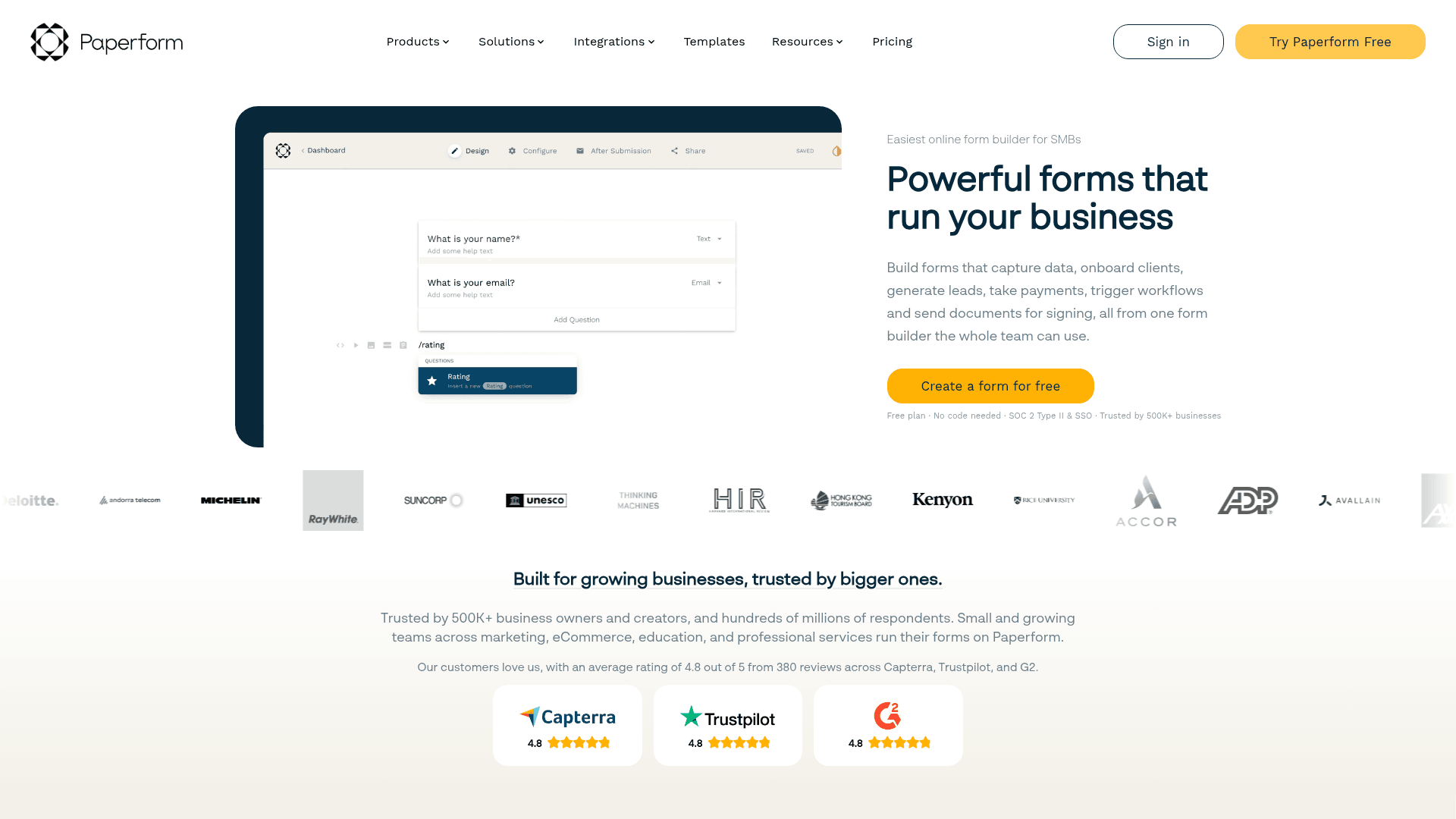
Paperform writes forms as pages, so the questions sit inside your copy rather than in a box below it. Next to a Wufoo form that difference is immediately visible.
Payments, scheduling and conditional logic are all included on paid tiers, letting one page qualify someone, book them in and take payment.
Monthly pricing runs $29 for Essentials, $59 for Pro and $129 for Business, above the advertised annual rates of $24, $49 and $99.
| Strengths | Weaknesses |
|---|---|
| Questions embedded in page copy | No permanent free plan, only a trial |
| Payments and scheduling built in | Submission limits on every tier |
| Highest G2 score in this comparison | More tool than a simple contact form needs |
| Custom domain from the Pro plan | Advertised prices are the annual rates |
| Plan | What you get |
|---|---|
| Free | No free plan; a 14-day trial is offered |
| Essentials | $29/mo ($24/mo billed yearly) |
| Pro | $59/mo ($49/mo billed yearly). Adds custom domain |
| Business | $129/mo ($99/mo billed yearly). Adds SSO |
Best for: landing pages where the form and the pitch are one thing.
The catch: you lose the free plan entirely, which is a real step down from Wufoo's 100 entries a month.
G2 rating: 4.8/5, from 86 reviews, the highest score in this comparison.
7. Typeform, the conversational survey builder

Typeform shows one question at a time, and on longer forms that lifts completion in a way a Wufoo form does not.
For customer research and qualitative surveys the difference is measurable, which is the whole argument for paying more per response.
It is the most expensive option here by response. Free covers 10 a month, Basic is $39 with 100, Plus $79 with 1,000, and Business $129 with 10,000.
| Strengths | Weaknesses |
|---|---|
| Best-executed conversational format | Free plan covers only 10 responses a month |
| Higher completion on longer forms | Highest cost per response in this list |
| AI drafts a full form from a prompt | Response caps on every tier |
| Strong drop-off analytics | Advertised prices are the annual rates |
| Plan | What you get |
|---|---|
| Free | $0. 10 responses/mo |
| Basic | $39/mo ($28/mo billed yearly). 100 responses/mo |
| Plus | $79/mo ($56/mo billed yearly). 1,000 responses/mo |
| Business | $129/mo ($91/mo billed yearly). 10,000 responses/mo |
Best for: surveys where a completed response is worth real money.
The catch: at volume this is far more expensive than the Wufoo plan you are leaving, so check your monthly numbers first.
G2 rating: 4.5/5, from 1,017 reviews. A large base, with cost the common complaint.
8. Tally, the free-plan alternative with unlimited submissions
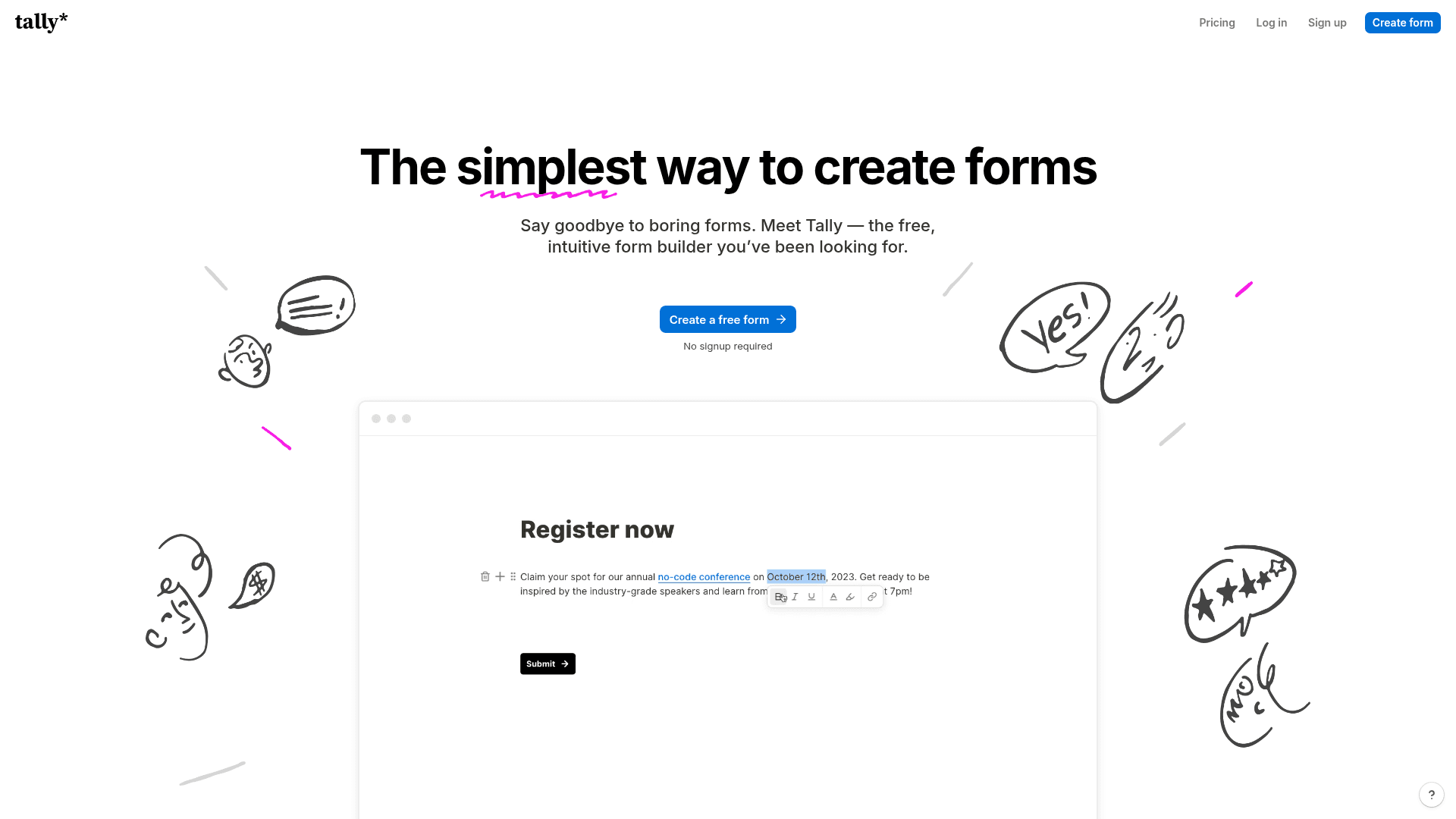
Tally solves the Wufoo entry cap by not having one. Forms and submissions are both unlimited on the free plan, along with conditional logic and file uploads.
The editor works like a text document, so building is faster than dragging fields onto a Wufoo canvas.
Paid plans start at $29 a month, above Wufoo's $22, but they exist to remove branding rather than to raise a limit.
| Strengths | Weaknesses |
|---|---|
| Unlimited forms and submissions free | Tally branding on the free plan |
| Conditional logic on the free plan | Analytics are basic |
| Document-style editor is quick to use | Fewer integrations than Wufoo |
| No overage charges at any tier | Advertised prices are the annual rates |
| Plan | What you get |
|---|---|
| Free | $0. Unlimited forms and submissions, logic, file uploads |
| Pro | $29/mo ($24/mo billed yearly). Removes branding, adds partial submissions |
| Business | $89/mo ($74/mo billed yearly). Adds data retention controls |
Best for: anyone who wants the cap gone without paying anything.
The catch: the free plan carries Tally branding, and the reporting is thinner than Wufoo's, which matters if you use its reports.
G2 rating: 4.5/5, from 305 reviews. A solid base for a relatively young product.
9. Zoho Forms, the CRM-integrated alternative
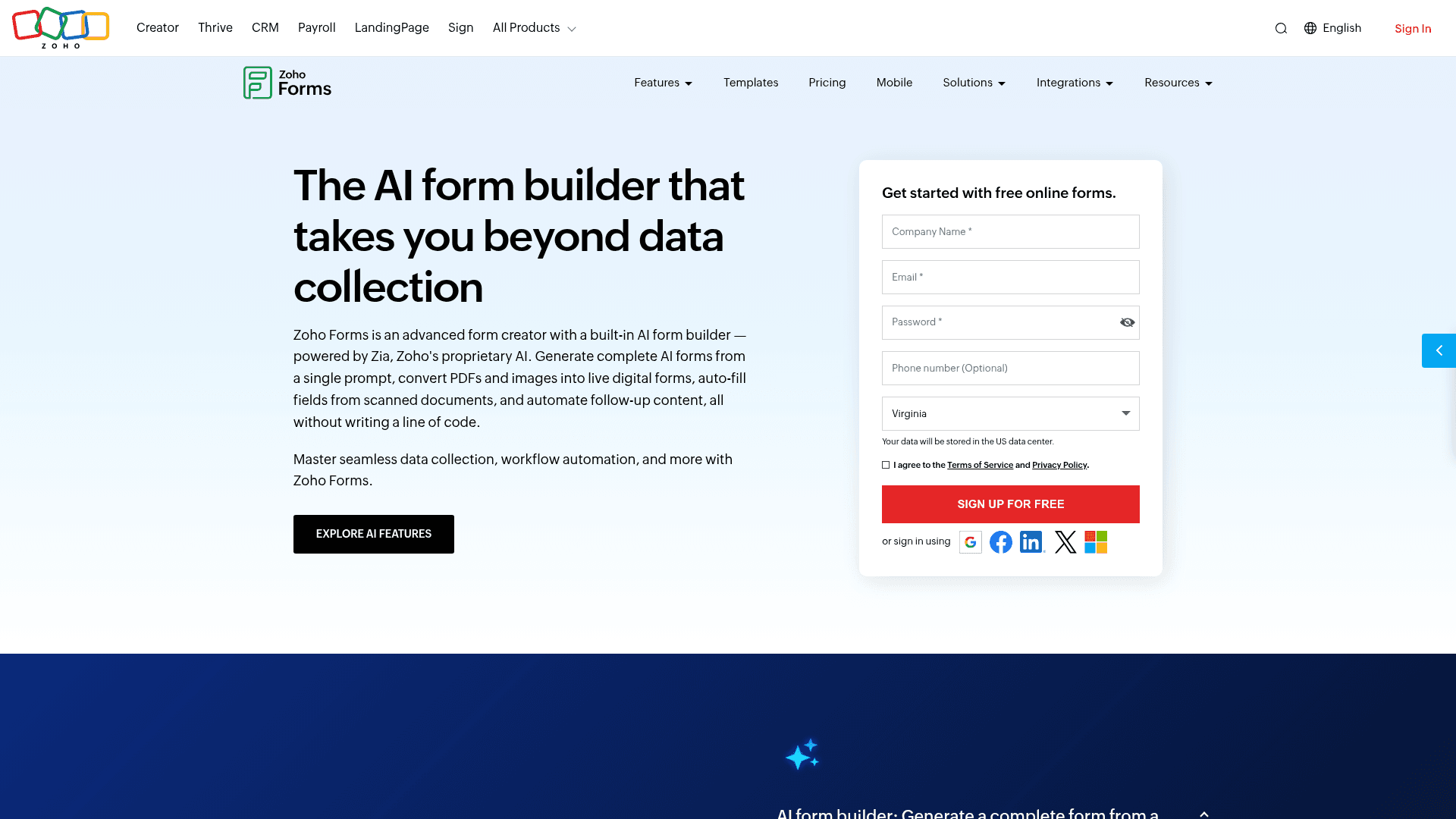
Zoho Forms only beats Wufoo if your stack is already Zoho, and then it beats it comfortably, because submissions land in Zoho CRM without a connector.
It is the cheapest paid tier here at $10 a month billed annually, and its free plan allows 500 submissions against Wufoo's 100.
It also ships offline mobile apps, which Wufoo has no answer to, and HIPAA on Premium at $90 a month.
| Strengths | Weaknesses |
|---|---|
| Cheapest paid tier at $10/mo | Free plan covers only 3 forms |
| 500 submissions a month free | Little value outside the Zoho suite |
| Routes into Zoho CRM natively | Interface feels as dated as Wufoo's |
| Offline mobile apps included | Prices are the annual-billed rates |
| HIPAA on Premium |
| Plan | What you get |
|---|---|
| Free | $0. 3 forms, 500 submissions/mo |
| Basic | $10/mo billed annually. 10,000 submissions/mo |
| Standard | $25/mo billed annually. 25 forms |
| Professional | $50/mo billed annually. Unlimited forms |
| Premium | $90/mo billed annually. HIPAA compliance |
Best for: Zoho shops that want forms feeding their CRM.
The catch: if you are leaving Wufoo because the interface feels old, this will not feel like an upgrade.
G2 rating: 4.4/5, from 129 reviews, at the lower end of this list.
10. Gravity Forms, the WordPress power tool
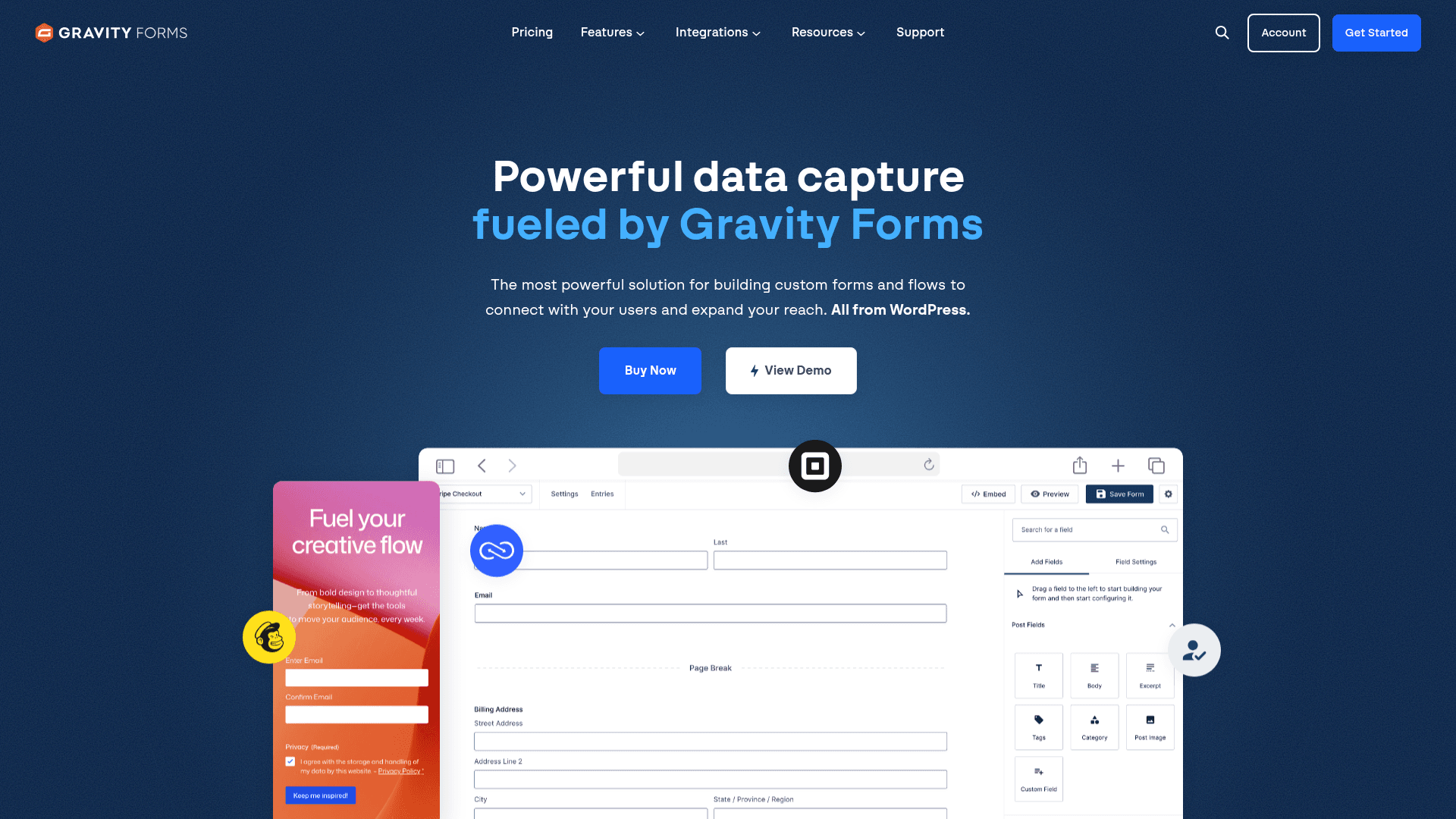
If your forms live on a WordPress site, Gravity Forms replaces Wufoo with something you host yourself, so the entries are yours and nothing is metered.
Its conditional logic is the deepest of any WordPress plugin, and 30+ first-party add-ons cover payments, CRM handoff and more.
Licensing is annual: $59 for Basic on one site, $159 for Pro, and $259 for Elite covering unlimited sites with every add-on.
| Strengths | Weaknesses |
|---|---|
| No entry metering at all once self-hosted | WordPress only |
| Deepest conditional logic on WordPress | No free plan, annual licence required |
| 30+ first-party add-ons | You own hosting, backups and patching |
| Elite covers unlimited sites for $259/year | Editor looks dated |
| Plan | What you get |
|---|---|
| Basic | $59/year. 1 site |
| Pro | $159/year. 3 sites, most add-ons |
| Elite | $259/year. Unlimited sites, all add-ons |
Best for: WordPress sites that want their form data self-hosted.
The catch: this only works if you run WordPress and are willing to own the hosting and patching that come with it.
G2 rating: 4.7/5, from 248 reviews built over years of WordPress use.
11. WPForms, the beginner-friendly WordPress alternative
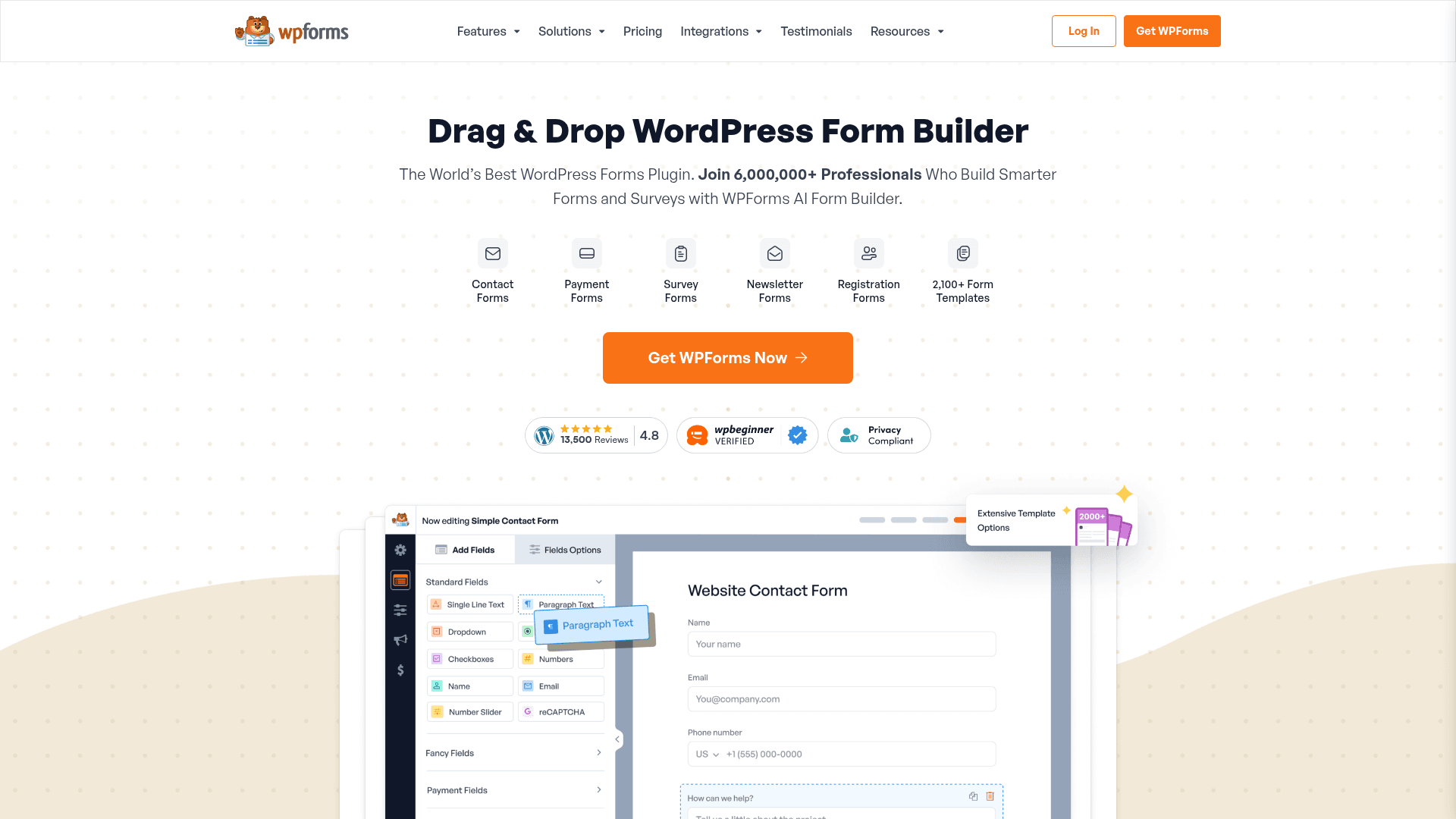
WPForms is the gentler WordPress option. The drag-and-drop builder is easier to learn than Gravity Forms and considerably easier than Wufoo's older interface.
Like any self-hosted plugin it does not meter entries, so the Wufoo overage problem disappears entirely.
Licensing is annual at renewal: $99 Basic, $199 Plus, $399 Pro and $599 Elite, with lower promotional rates in the first year.
| Strengths | Weaknesses |
|---|---|
| Easiest WordPress form builder to learn | WordPress only |
| No entry metering once self-hosted | Payments need the Pro licence at $399/year |
| One licence covers unlimited submissions | Renewal prices exceed first-year rates |
| 2,000+ templates | No monthly billing option |
| Plan | What you get |
|---|---|
| Lite | Free WordPress plugin |
| Basic | $99/year at renewal. 1 site |
| Plus | $199/year at renewal |
| Pro | $399/year at renewal. Adds payments and Conversational Forms |
| Elite | $599/year at renewal. Unlimited sites |
Best for: WordPress users who want the simplest possible builder.
The catch: payments sit on the Pro licence at $399 a year, so a basic paid form costs more than it first appears.
G2 rating: 4.7/5, from 971 reviews. A large base among WordPress users.
12. HubSpot Forms, the marketing-integrated alternative
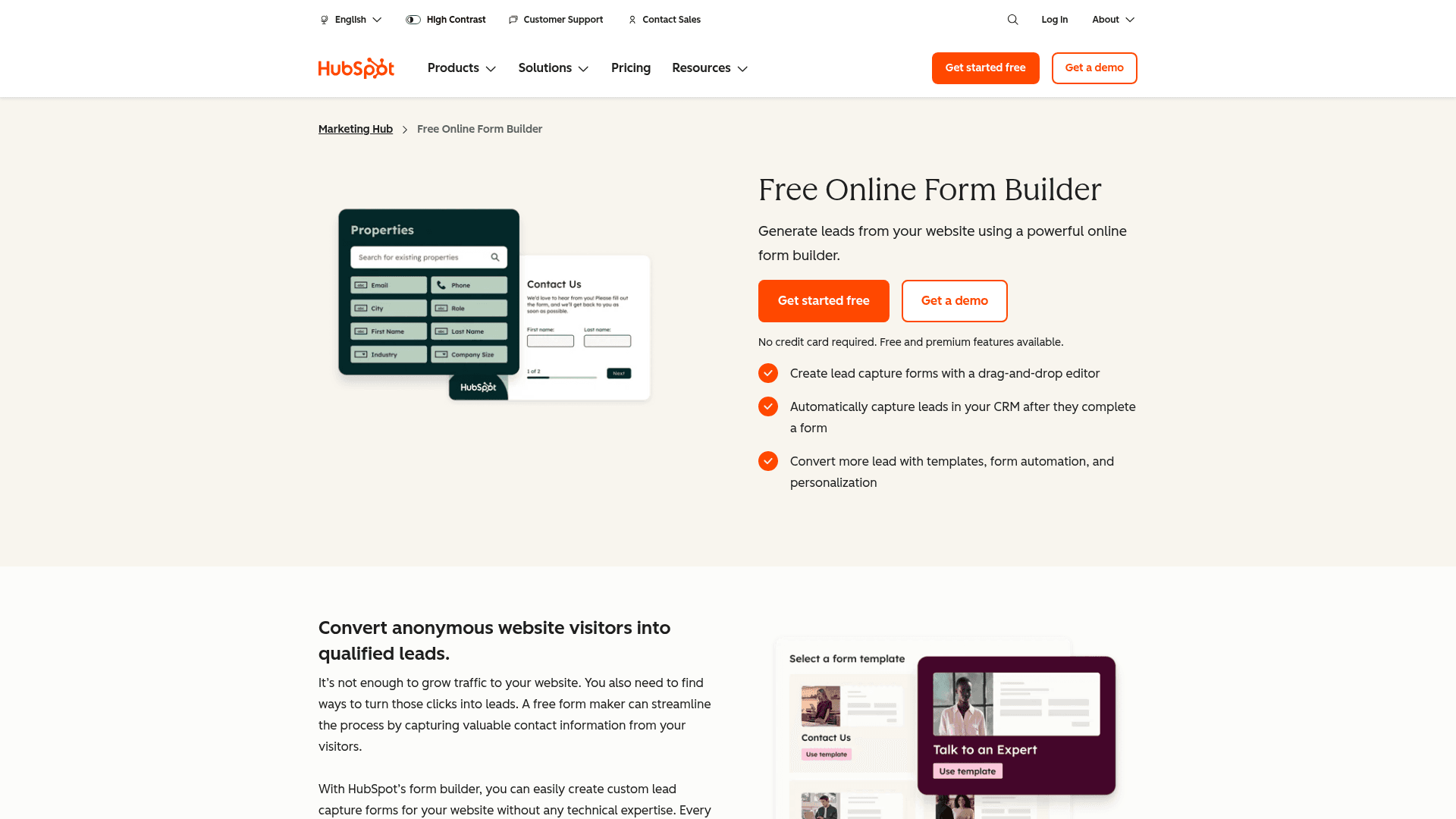
HubSpot answers a question Wufoo never tried to: what happens to the submission afterwards. Every entry becomes a CRM contact automatically.
Submissions are unlimited on the free tier with HubSpot branding, which removes the Wufoo cap at no cost, and free email marketing comes with it.
Paid Marketing Hub plans start at $20 per seat a month, rising steeply to $800 for Professional and $3,600 for Enterprise.
| Strengths | Weaknesses |
|---|---|
| Unlimited submissions on the free plan | Form builder is basic next to the specialists |
| Every submission becomes a CRM contact | HubSpot branding on free forms |
| Free CRM and email marketing included | Paid tiers jump to $800/mo |
| Strong list segmentation | Professional and Enterprise carry onboarding fees |
| Plan | What you get |
|---|---|
| Free Tools | $0. Unlimited submissions with HubSpot branding, free CRM |
| Marketing Hub Starter | $20/seat/mo |
| Marketing Hub Professional | $800/mo, plus a one-time onboarding fee |
| Marketing Hub Enterprise | $3,600/mo, plus a one-time onboarding fee |
Best for: marketing teams that want submissions landing in a CRM.
The catch: the builder itself is weaker than Wufoo's. You are buying the CRM behind it, not the form.
G2 rating: 4.4/5, from 12,747 reviews across HubSpot Marketing Hub.
13. SurveyMonkey, the survey-heavy alternative from Wufoo's parent
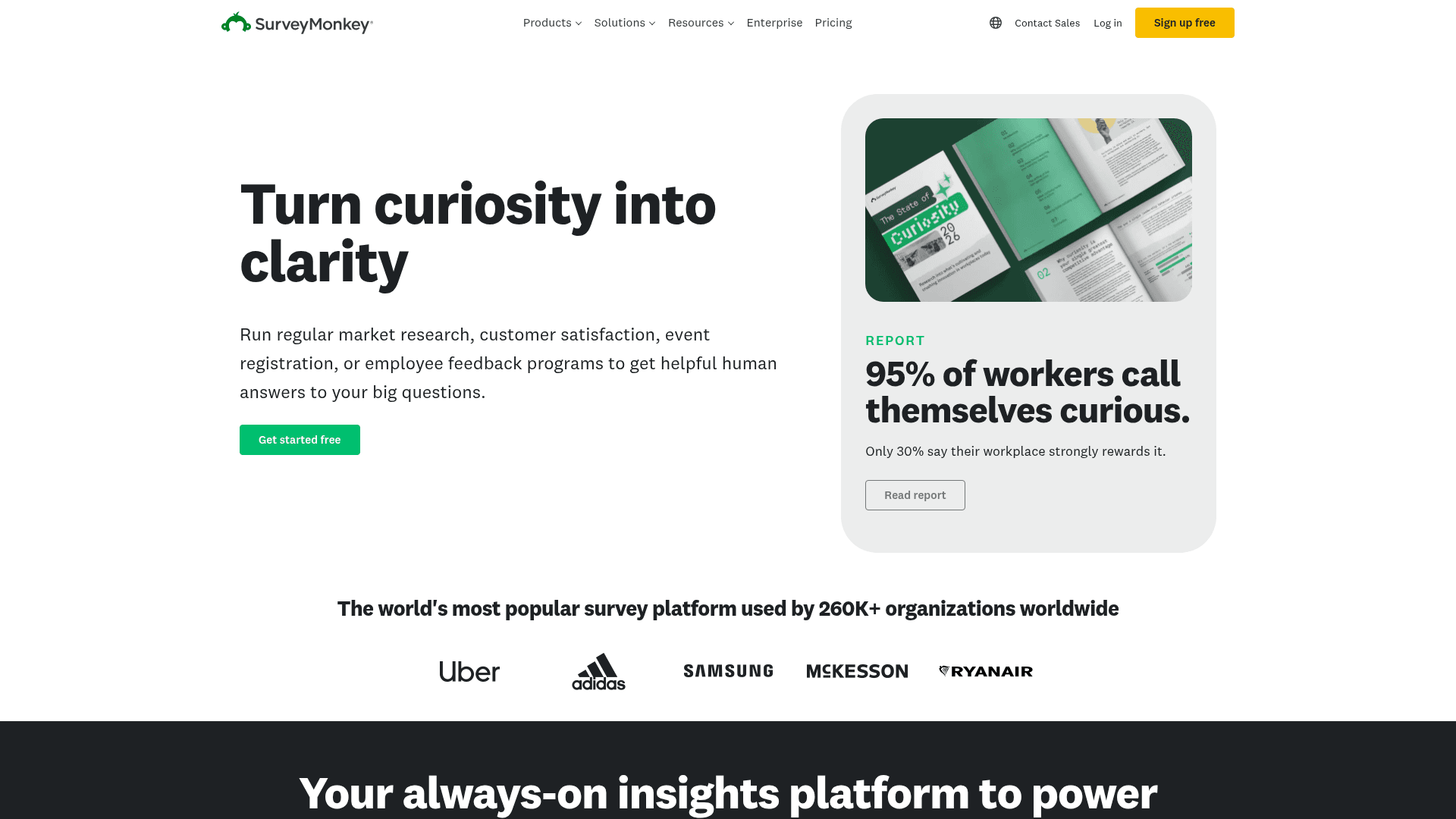
SurveyMonkey and Wufoo share an owner, so moving between them is a sideways step inside the same company rather than a departure.
It is built for surveys rather than forms, with question banks, benchmarking and analysis that Wufoo does not attempt.
Team pricing is per user: Team Advantage at $30 and Team Premier at $92 per user a month, with $0.15 charged per response over the plan allowance.
| Strengths | Weaknesses |
|---|---|
| Purpose-built survey analysis and reporting | Priced per user, so small teams pay more |
| Question banks and benchmarking data | $0.15 charged per response over the limit |
| Very large review base on G2 | Individual plan pricing is not published |
| Established brand recognition with respondents | Overkill for a simple contact form |
| Plan | What you get |
|---|---|
| Free | $0. Limited questions and responses per survey |
| Team Advantage | $30/user/mo |
| Team Premier | $92/user/mo |
| Extra responses | $0.15 per response over the plan allowance |
Best for: teams whose real need is survey analysis, not form collection.
The catch: it carries a per-response overage just as Wufoo does, so the charge you were escaping follows you here.
G2 rating: 4.4/5, from 23,901 reviews. A very large base reflecting long familiarity.
14. Alchemer, the enterprise survey research alternative
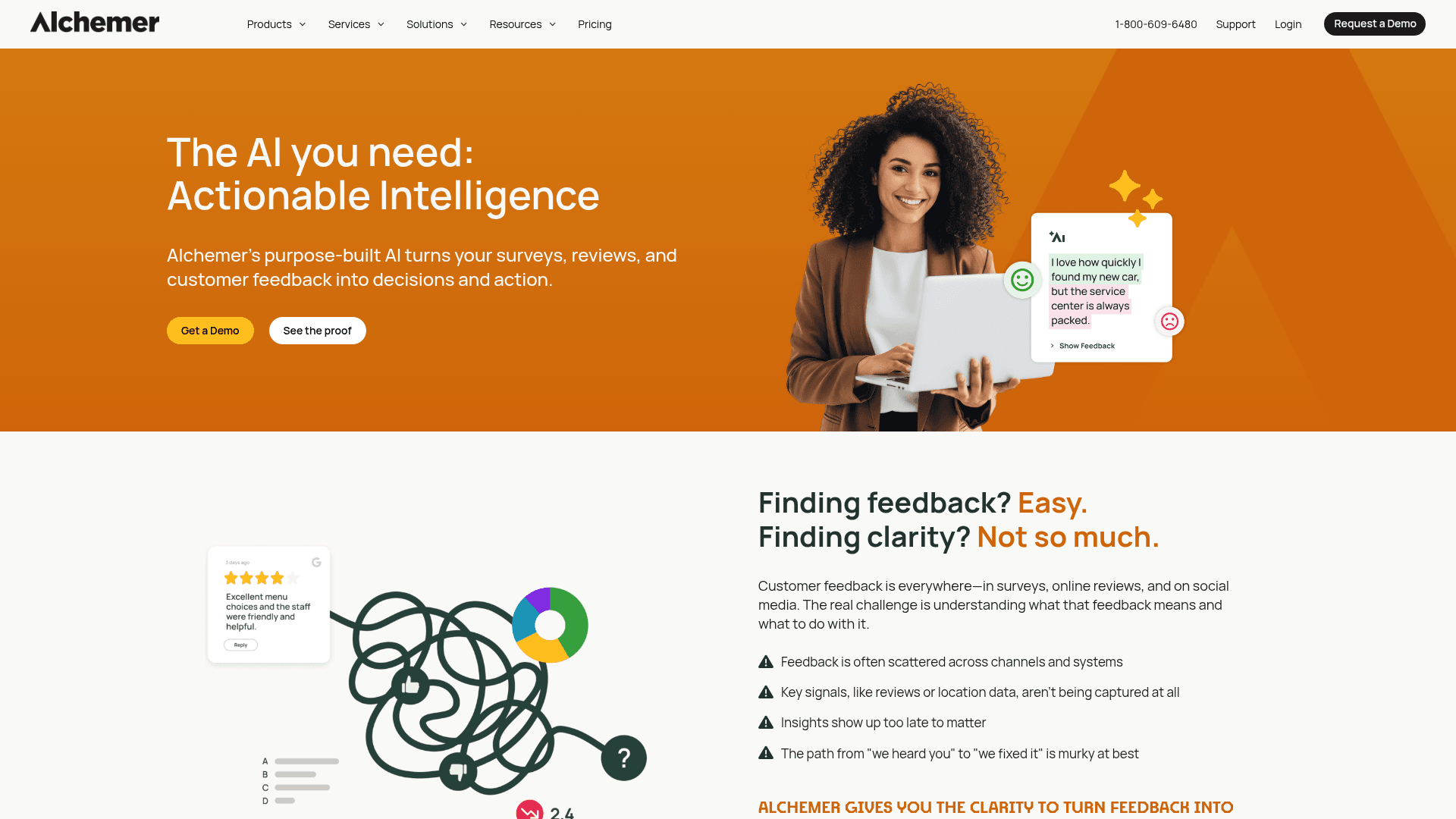
Alchemer sits well above Wufoo in both capability and price, aimed at market research teams that need piping, quotas and longitudinal studies.
Its reporting goes considerably further than anything Wufoo offers, with cross-tabulation and segmentation built in.
Pricing is per user per month: Collaborator at $55, Professional at $165 and Full Access at $275, with the upper two capped at 3 users.
| Strengths | Weaknesses |
|---|---|
| Research-grade logic and reporting | Per-user pricing gets expensive quickly |
| Piping, quotas and longitudinal studies | Professional and Full Access cap at 3 users |
| Cross-tabulation built into reporting | No free plan, only a trial |
| Established in academic and market research | Overkill for ordinary form collection |
| Plan | What you get |
|---|---|
| Free | No free plan; a 7-day trial is offered |
| Collaborator | $55/user/mo ($315/user/year) |
| Professional | $165/user/mo, capped at 3 users |
| Full Access | $275/user/mo, capped at 3 users |
| Enterprise | Custom pricing |
Best for: research teams that outgrew what a form builder can report on.
The catch: at $55 per user a month it costs more than Wufoo's second tier for one seat, and the user caps bite quickly.
G2 rating: 4.4/5, from 956 reviews. A large base, with cost the recurring theme.
15. Microsoft Forms, the alternative for Microsoft 365 shops
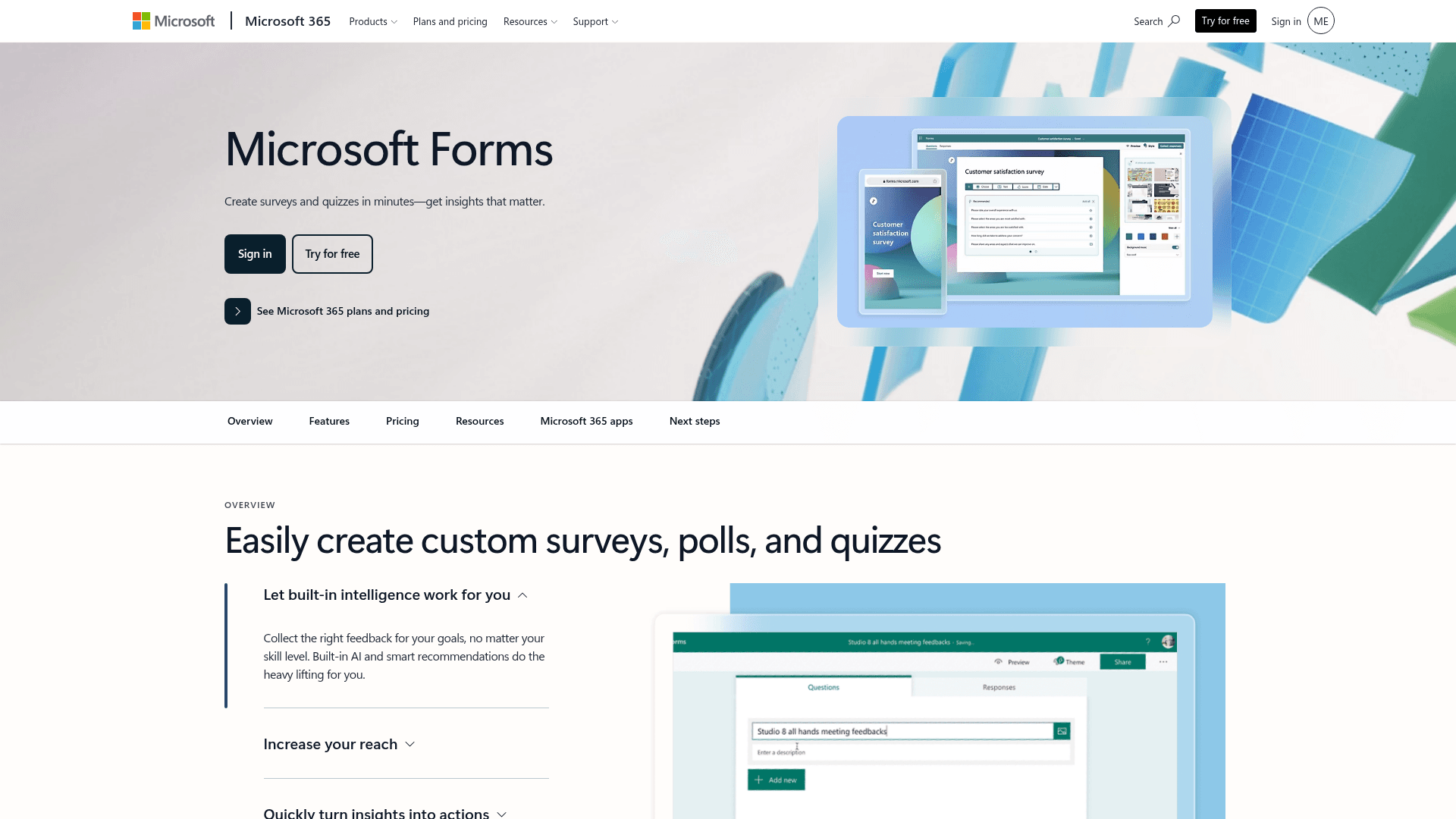
If your organisation pays for Microsoft 365, Microsoft Forms is already provisioned, which makes the cost comparison against Wufoo very short.
Results land in Excel and polls run inside Teams meetings, covering most internal collection without a separate vendor.
A personal Microsoft account caps at 200 responses per form, which is double Wufoo's free allowance. Inside a tenant those limits lift considerably.
| Strengths | Weaknesses |
|---|---|
| No extra cost inside Microsoft 365 | Very limited design control |
| 200 responses per form free, double Wufoo | Basic branching only |
| Results flow into Excel | No native payment collection |
| Inherits tenant security | No value outside Microsoft |
| Plan | What you get |
|---|---|
| Free | $0 with a personal Microsoft account. 200 responses per form |
| M365 Business Basic | $7/user/mo, annual basis |
| M365 Business Standard with Copilot | $23.50/user/mo, annual basis |
| M365 Business Premium with Copilot | $32/user/mo, annual basis |
Best for: internal forms in organisations already on Microsoft 365.
The catch: there are no payments and almost no design control, so it replaces internal Wufoo forms rather than customer-facing ones.
G2 rating: 4.4/5, from 476 reviews, which fits its internal-tool scope.
16. Google Forms, the free-tier alternative
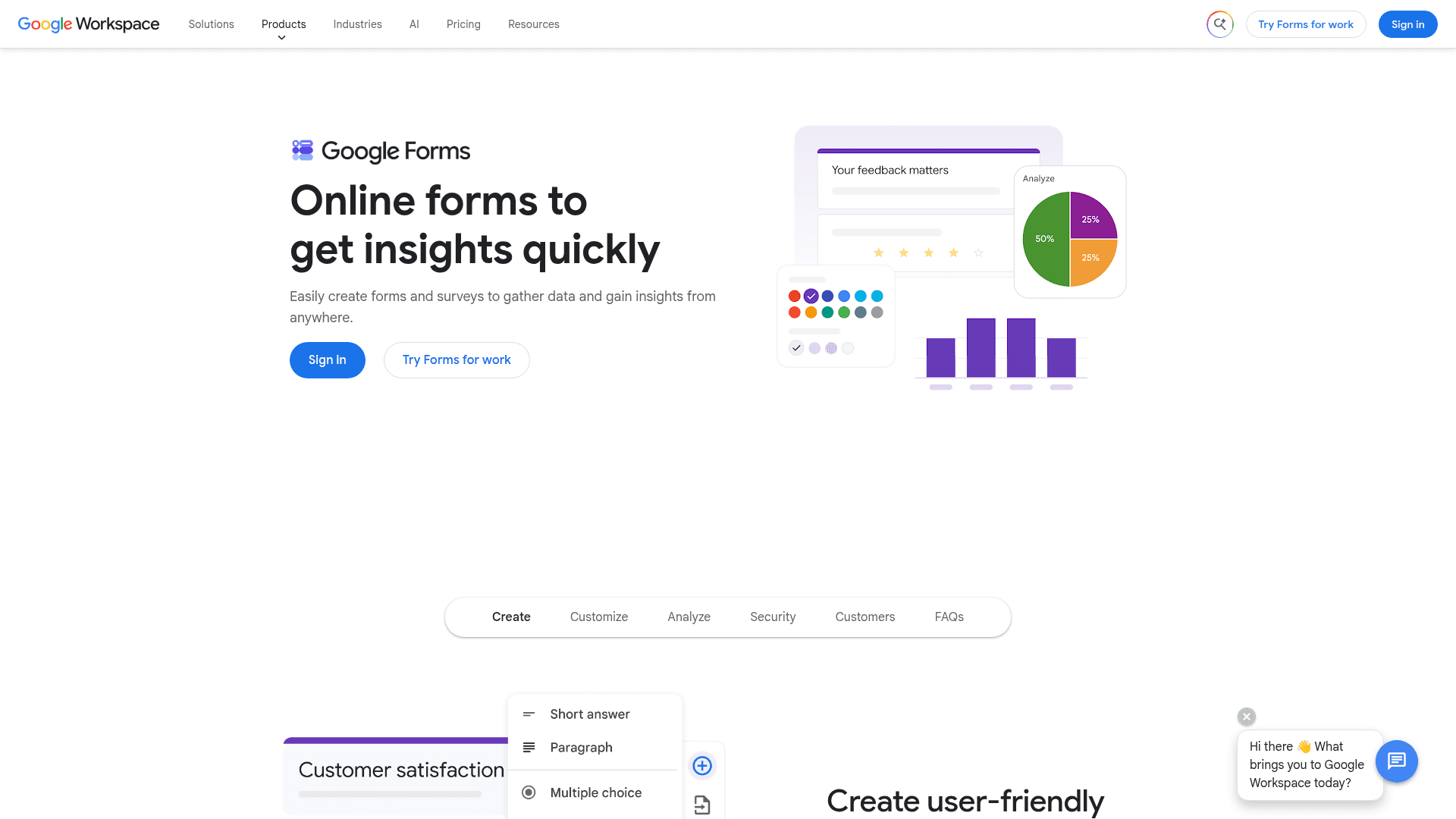
Google Forms removes the Wufoo cap for nothing. It is free with any Google account and has no response limit worth planning around.
Answers sync into Sheets, several people can edit the same form at once, and quiz scoring is built in.
There is no paid Forms tier. It arrives with Google Workspace, where Business Starter is $7 per user a month on an annual basis.
| Strengths | Weaknesses |
|---|---|
| Free with any Google account | Very limited design control |
| No practical response cap | Skip-to-section logic only |
| Answers sync straight into Sheets | No native payment collection |
| Real-time collaborative editing | Google branding stays on every form |
| Plan | What you get |
|---|---|
| Free | $0 with any Google account. Effectively unlimited responses |
| Workspace Business Starter | $7/user/mo, annual basis |
| Workspace Business Standard | $14/user/mo, annual basis |
| Workspace Business Plus | $22/user/mo, annual basis |
Best for: internal forms where cost matters more than appearance.
The catch: every Google Form looks like a Google Form, so this works internally and rarely on a customer-facing page.
G2 rating: Google Forms has no standalone G2 profile. The 4.6/5 from 48,175 reviews quoted elsewhere covers Google Workspace as a whole.
17. Formstack, the regulated-industries enterprise alternative
Formstack is where Wufoo users go when compliance becomes a procurement requirement rather than a preference. HIPAA comes with a BAA, alongside audit trails and granular permissions.
Its Salesforce integration maps form fields to Salesforce records natively, which no other tool here does to the same depth.
It is also the highest entry price in this list at $99 a month, more than four times Wufoo's first paid tier.
| Strengths | Weaknesses |
|---|---|
| HIPAA with a BAA and full audit trails | $99/mo entry point, the highest here |
| Native Salesforce field mapping | No free plan at all |
| Documents and e-signature in the Suite | Interface feels dated in places |
| Granular permissions for large teams | Advertised prices are the annual rates |
| Plan | What you get |
|---|---|
| Free | No free plan; a trial is offered |
| Forms | $99/mo ($83/mo billed yearly) |
| Suite (Forms, Documents, Sign) | $299/mo ($250/mo billed yearly) |
| Enterprise | Custom pricing |
Best for: regulated teams that need a BAA and native Salesforce mapping.
The catch: this is a compliance purchase at four times the Wufoo price. Nobody moves here to save money.
G2 rating: 4.3/5, from 471 reviews. A large base, with cost the recurring theme.
Wufoo capping your responses this month?
Formester ships unlimited responses on the free plan, with an AI form generator and payments through Stripe and PayPal. No 100-entry ceiling, no $210-a-month Ultimate upgrade.
Try Formester freeFree forever · No credit card · 56,000+ teams
Which Wufoo alternative should you actually pick?
Start with why you are leaving. If it is the entry cap or the $0.05 overage, Formester and Tally remove both outright and Google Forms has no practical limit either.
If it is the interface, Fillout and forms.app are the two that will feel genuinely modern, and Paperform if your forms are really landing pages.
If you need something Wufoo never offered, the answer depends on which thing. HIPAA points to Jotform or Formstack, deep calculations to Cognito Forms, and a CRM behind the form to HubSpot.
Frequently asked questions
What is the best Wufoo alternative?
Why do people leave Wufoo?
Is there a free Wufoo alternative with no limits?
Which Wufoo alternative is cheapest?
Does any Wufoo alternative offer HIPAA compliance?
Can I move my Wufoo forms to another tool?
Which alternative is closest to Wufoo?
Do the alternatives charge for extra responses?
Verdict
Wufoo is not a bad product. It is stable, predictable and has been doing this longer than most of the tools on this list.
What it has not done is keep up.
The 100-entry free plan, the overage charge, the missing AI generation and the aging interface are all reasons people move, and each one points to a different replacement.
Formester covers the metering complaint most completely; Cognito Forms is the closest thing to Wufoo done properly; Fillout is the one that feels like a different decade.