The 60-second verdict
What Qualtrics is: An enterprise Experience Management (XM) platform sold in three suites (Customer Experience, Employee Experience, Strategy & Research), each with multiple product SKUs inside. Sales-only pricing, no free tier, no self-serve tier. Every plan on the pricing page shows "Request Pricing," including the entry-level ones.
What it does well: Deep, mature analytics engine. AI-guided insights across CX, EX, and research workflows. Multi-touchpoint programs (surveys plus contact center plus digital analytics) live in one platform. Enterprise CX and EX teams standardize on it because the whole vendor stack (Salesforce, ServiceNow, Adobe, SAP) plugs in cleanly.
What is annoying: Zero price transparency. You cannot form a budget from the pricing page. Buyer reports and analyst commentary put contracts in the $25,000 to $100,000+ per year range, but Qualtrics itself will not confirm publicly. Implementation is heavy. No option to sign up, run a small survey, and see how it feels.
Bottom line: If you run a global CX or EX program with multi-year commitment and a real budget, Qualtrics is a defensible enterprise choice. If your job is closer to "collect some responses this quarter" or "run one engagement survey for a 50-person team," you are shopping in the wrong aisle and should look at Formester or SurveyMonkey.
G2 rating: 4.4/5 (3,017 reviews for Qualtrics XM)
What Qualtrics is (and isn't)
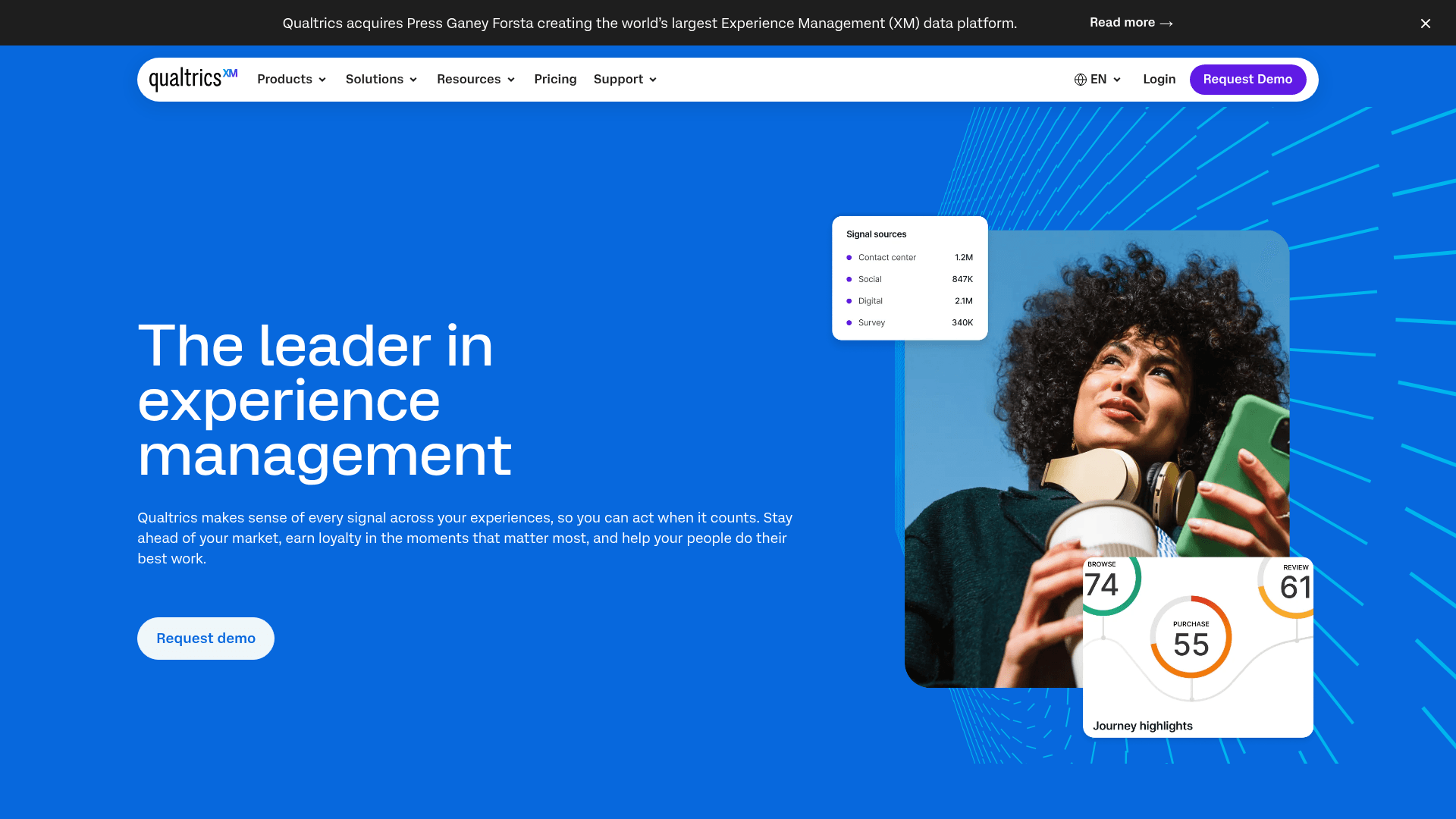
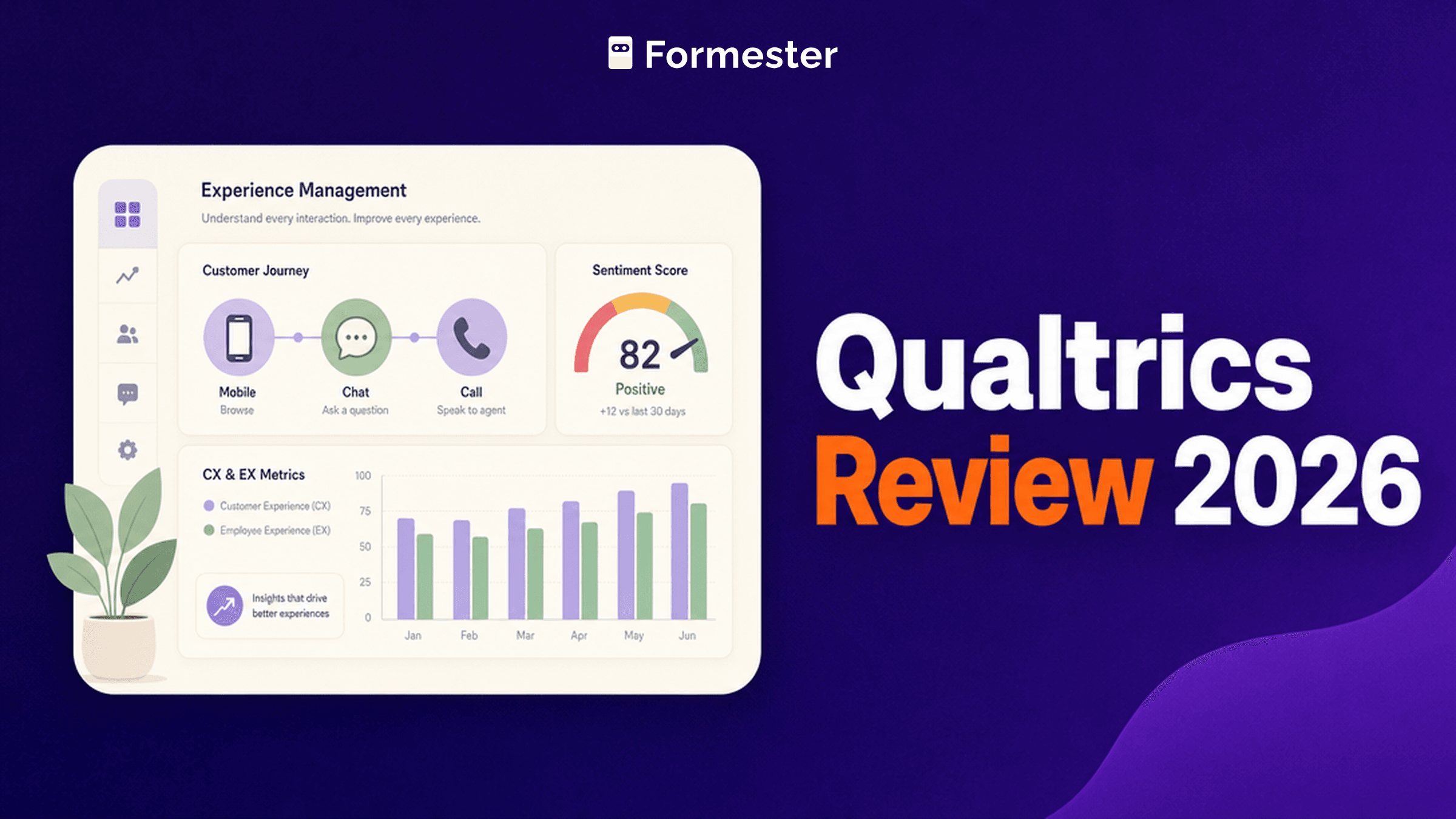
Qualtrics is an enterprise Experience Management platform, not a survey tool. That single distinction sets the whole product apart from anything a small or mid-market team can buy off the shelf.
An XM platform is designed for programs that span years, span departments, and span data types. A CX team hooks it into Salesforce and a contact center. An EX team runs quarterly engagement plus lifecycle plus pulse surveys with SSO into Workday. A research team uses it for panel-based studies with quota sampling. All of those workloads share a data model, a security posture, and an enterprise contract.
A survey tool like SurveyMonkey or Typeform runs the same measurement loop but on a smaller footprint and with self-serve pricing. A form builder like Formester runs a different job entirely (signups, orders, quizzes, payment collection).
If your team wants to sign up on a Tuesday, run a 20-response survey by Friday, and pay under $100, Qualtrics is not the tool. If your team is signing a two-year XM contract, Qualtrics is on the shortlist alongside Medallia and (much less commonly) Alchemer Enterprise.
Pricing: sales-only, no self-serve
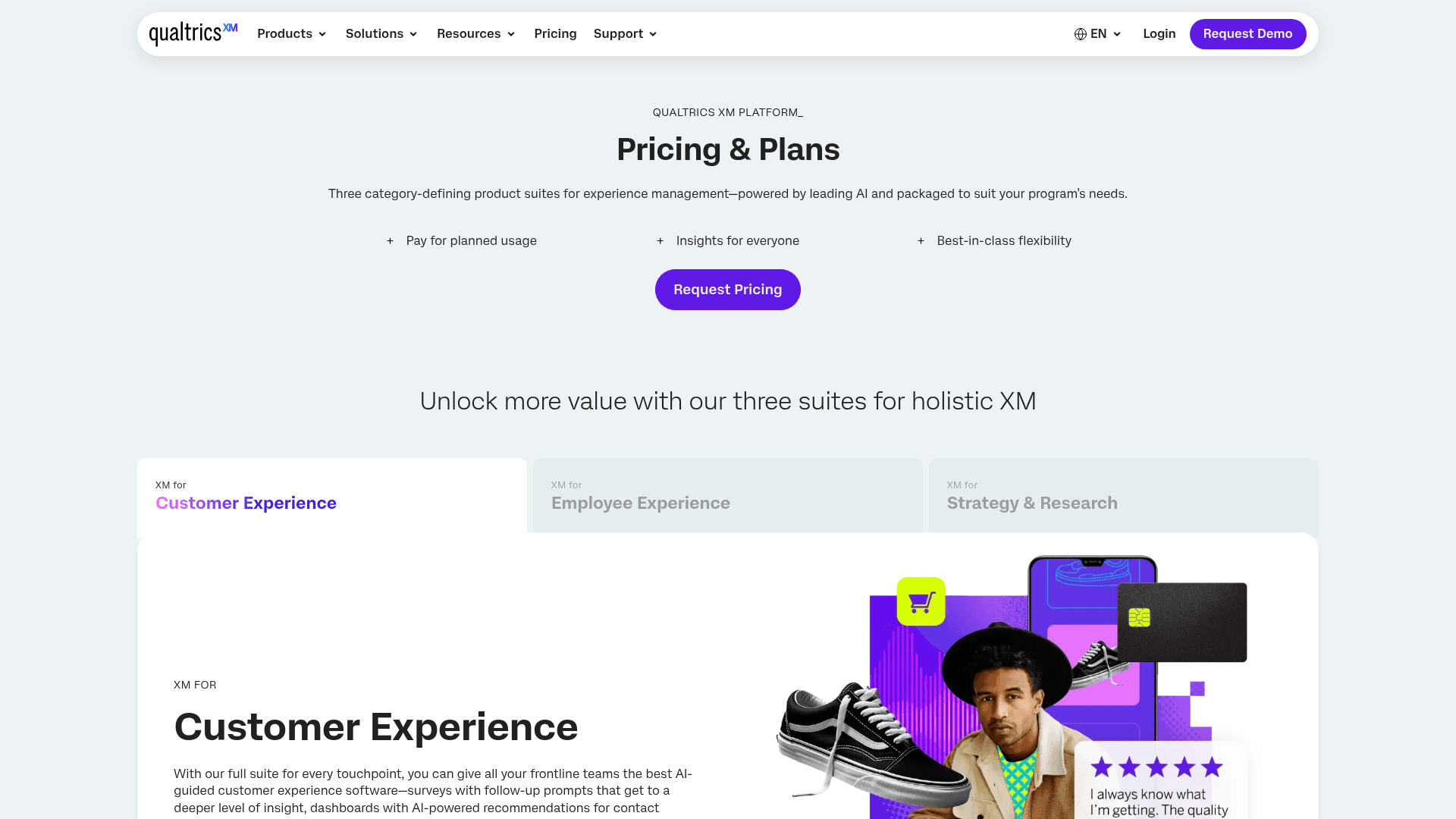
Qualtrics publishes zero prices. Every product card on the pricing page ends with the same button: "Request Pricing." This applies at every level, from the entry Foundational tier to full-suite Enterprise deals.
We scraped the live pricing page and confirmed:
- No free plan. Not even a trial button on the main tiers.
- No published price for any product. Not for CX Foundational, not for Frontline Digital, not for Foundational EX, not for Strategic Brand. Every single product asks you to talk to sales first.
- Three suite categories, each holding four to five product SKUs:
- XM for Customer Experience: CX Foundational, Frontline Digital, Frontline Location, Frontline Care - XM for Employee Experience: Foundational EX, Engagement, Lifecycle, Pulse - XM for Strategy & Research: Foundational Research, Strategic UX, Strategic Brand
What buyers actually pay varies dramatically by team size, suite mix, and negotiation. Public analyst commentary and G2 reviewer notes commonly cite contracts in the $25,000 to $100,000+ per year range for a real deployment. Higher for global CX or multi-suite programs. We are not going to invent a number that Qualtrics does not publish, so if you need the actual figure, book a sales call and get a written quote.
Practical implication: You cannot budget-scope Qualtrics from a spreadsheet. You cannot compare it apples-to-apples with SurveyMonkey Team Advantage at $30 per user per month or Formester Business at $45 per month. Any comparison is going to be "list price for the cheaper tool vs. estimated contract for Qualtrics," and the second half of that comparison changes on every sales cycle.
Platform and product experience
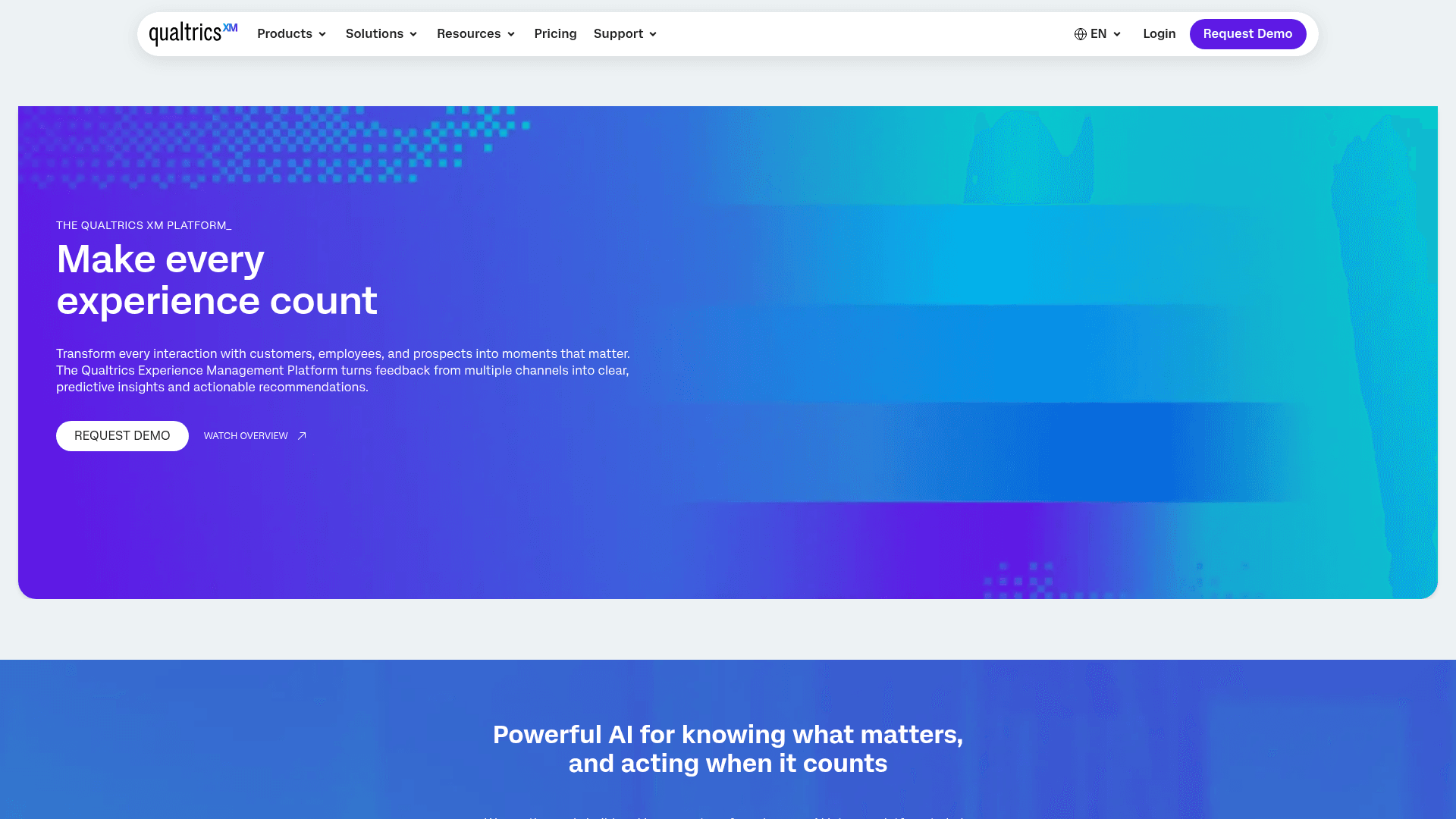
Qualtrics ships one platform with three suites layered on top. Under the hood, the same survey engine, distribution logic, analysis dashboard, and iQ AI features power CX, EX, and Research work. What changes between suites is the template library, the workflow automations, and the target integrations.
What the platform does well:
- The survey editor covers everything a modern survey builder does: skip logic, piping, quota management, randomization, multilingual surveys, embedded data, custom variables. All native, all polished.
- iQ (Qualtrics's AI layer) surfaces themes in open-ended text, flags at-risk customers, predicts drivers of NPS, and prompts follow-up questions inside surveys. AI is not bolted on. It is threaded through the analysis loop.
- Enterprise integrations are the strongest in the category. Salesforce, ServiceNow, Adobe, SAP, Workday, and Microsoft plug in with first-party connectors. Contact center integrations (Genesys, Cisco, Amazon Connect) power omnichannel CX programs.
- Multi-touchpoint data unification. Feedback from a phone call, a chat, a mobile app in-product survey, and a post-purchase email all land in the same dashboard with the same customer key.
- Governance and permissions are enterprise-grade. Role-based access down to individual survey questions, audit logs, data residency choices for EU and US customers.
What is heavier than teams expect:
- Implementation is a project, not an install. Most Qualtrics deployments take six to twelve weeks with either an in-house admin team or Qualtrics services. Small teams sometimes underbudget the professional services line.
- The editor is powerful but crowded. If your evaluators are used to Typeform's one-question-per-page or Formester's clean canvas, the Qualtrics editor will feel dense on day one. Muscle memory shows up around day 30.
- Some product lines require additional add-ons even on a paid tier. Text iQ, Predict iQ, and advanced dashboards live behind separate SKUs in some contracts.
Suites and product coverage
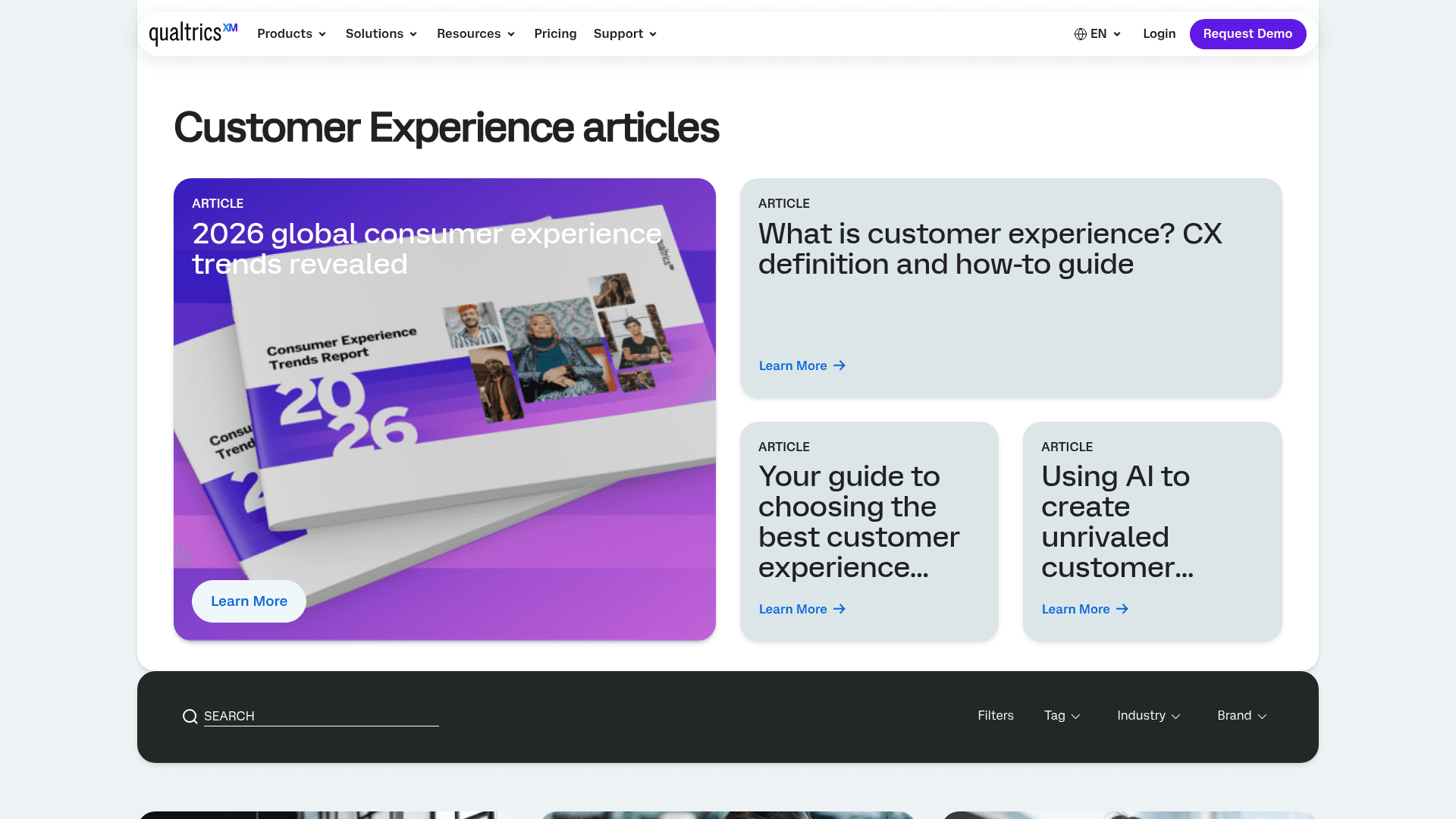
XM for Customer Experience anchors most Qualtrics deployments. It covers NPS programs, CSAT, closed-loop feedback with contact-center integration, and digital customer analytics. The Frontline products (Digital, Location, Care) unlock specific use cases: Digital for e-commerce and product analytics, Location for retail and branch experience, Care for contact-center CX.
XM for Employee Experience is where Qualtrics competes head-on with Culture Amp, Peakon (Workday), and Glint (LinkedIn Talent). Engagement, Lifecycle (onboarding, exit, milestones), and Pulse (frequent short surveys) cover the core HR listening stack. Foundational EX is the entry point for smaller programs.
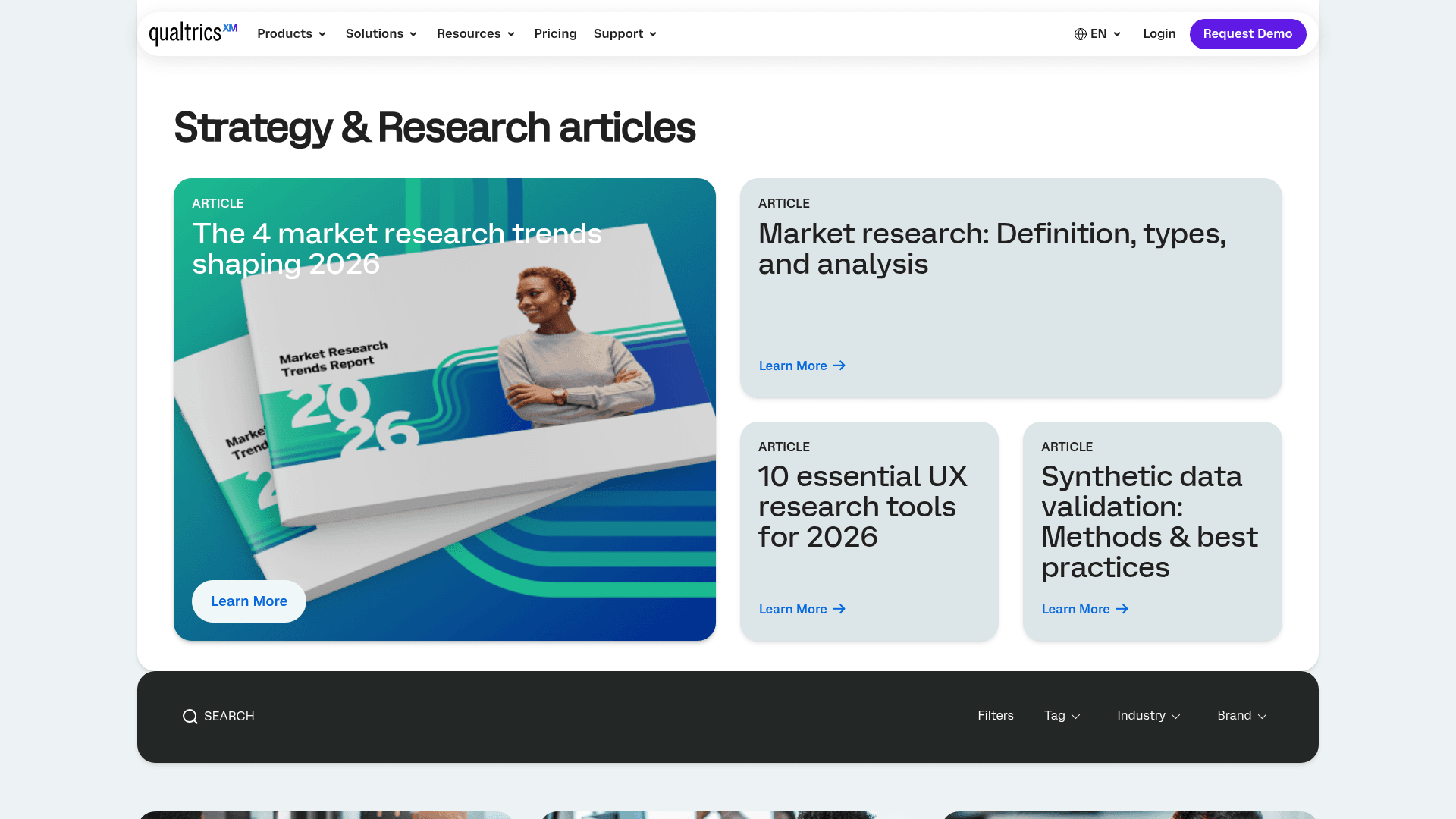
XM for Strategy & Research is the market-research suite. Foundational Research covers standard survey research; Strategic UX covers concept, usability, and testing workflows; Strategic Brand covers brand tracking, ad testing, and long-running brand studies. Qualtrics is strong here, especially for teams that also license the panel (Prolific-style respondent sourcing) through Qualtrics.
Each suite carries its own template library, its own AI automations, and its own list of pre-built dashboards. What ties them together is the shared data model and the shared integration layer.
Real-world use cases where Qualtrics wins
Global enterprise CX programs. Multi-region, multi-language, multi-channel (call, chat, web, email, mobile) with real-time closed-loop workflows into Salesforce and the contact center. Qualtrics handles this end-to-end. Almost nobody else does.
Enterprise employee listening at scale. Annual engagement plus lifecycle plus pulse across 5,000+ employees, with SSO into Workday and dashboards for every people manager. Culture Amp and Peakon compete here; Qualtrics still wins on integration depth for large enterprises.
Longitudinal brand-tracking studies. Multi-year brand studies with consistent methodology, quota sampling, weighting, and a panel. Qualtrics Strategy & Research is the incumbent choice for consumer research teams at Fortune 500 companies.
Regulated-industry CX (finance, healthcare, telco). Data residency, audit logs, role-based access, integration with regulated CRM systems. Qualtrics has the enterprise plumbing to survive a compliance review. Most survey and form tools do not.
XM programs that span CX + EX + Research on one platform. Consolidating three data models into one, sharing integrations, and running cross-program dashboards. This is the pitch Qualtrics's sales team leads with, and for programs that big it holds up.
Where Qualtrics falls short
No self-serve pricing at any level. The pricing page is a lead-capture form. Buyers who need a rough number to build a budget cannot get one without a sales conversation. For smaller teams, that friction alone is a dealbreaker.
Overkill for most day-to-day use cases. A marketing team that wants a quick pre-webinar registration form or an ad-hoc customer feedback survey is going to feel every ounce of the enterprise weight. There is no low-touch way to just spin something up in fifteen minutes.
Long implementation cycles. Six to twelve weeks is typical for a real deployment. Add Qualtrics Professional Services in most cases. Teams that expected "buy license, log in, run survey" are surprised.
Add-on SKUs on top of the base contract. Text iQ, Predict iQ, dashboards, and some connector packages sit on separate line items in many contracts. Total cost is higher than the initial quote unless every needed feature is explicit on day one.
Contract lock-in. Most Qualtrics deals are annual or multi-year commitments. Switching mid-cycle is expensive. If your team's needs change, you are paying for capacity you cannot easily downsize.
Category creep and pricing opacity make TCO hard to plan. Qualtrics has expanded from a survey vendor to a full XM platform to a data-plus-AI stack. Each expansion added SKUs. The result is that a "Qualtrics contract" today covers dramatically more surface than three years ago, and the actual price surface has grown with it.
No workable path for freelancers, solo operators, or small teams. This is not a criticism as much as a fit reality. Qualtrics does not build for teams under 50 people. If your team is smaller than that, buying Qualtrics is like buying a truck to move a bookshelf.
Pros and cons summary
Pros:
- Deepest analytics stack in the survey and XM category (iQ text analysis, driver analysis, predictive scoring)
- Enterprise integrations that plug into Salesforce, ServiceNow, Workday, SAP, Adobe out of the box
- Genuine multi-suite platform for CX, EX, and Research on shared data
- Contact center and omnichannel data unification
- Enterprise-grade governance, permissions, audit logs, and regional data residency
- Mature panel and research capabilities for market-research teams
- Strong brand-tracking and longitudinal-study support
Cons:
- Zero published prices at any tier
- No free tier and no self-serve option
- Six to twelve week implementation is typical
- Add-on SKUs push total contract cost above initial quote
- Editor is dense and takes weeks to feel fluent
- Annual or multi-year contract lock-in
- Not a fit for teams under 50 people or budget under mid-five figures
Published prices. No sales call to see a dollar figure
Formester ships forms with prices on the page. Free forever plan, Personal at $12, Business at $45. Everything unlimited (forms, responses), native Stripe / PayPal, and offline capture. Skip the enterprise contract when you don't need it.
Free forever plan • No credit card • Setup in 2 minutes
When Formester is the better pick
You need a self-serve, published-price tool. Formester's pricing is on the page in dollar figures. Free forever. Personal at $12 per month. Business at $45 per month. No sales call required to know your line item.
You are building forms, not running an enterprise XM program. Contact forms, lead capture, order forms with payment, event signups, quizzes, application forms. Formester is built for these workflows with native Stripe and PayPal, conditional logic, file uploads, and offline forms.
You want AI form generation from a prompt or PDF. Formester's AI form generator builds a full form from a prompt, a question list, or an uploaded PDF. Qualtrics has AI, but not this specific creation workflow, and Qualtrics AI is gated behind an enterprise contract regardless.
Your team is under 50 people. Qualtrics does not build for you. Formester's Free and Personal tiers cover most solo, freelancer, and small-team workflows without the enterprise overhead.
You need offline capture for field teams. Formester's offline forms ship as PWAs that queue responses locally. Qualtrics has an offline mobile SDK too, but again it is enterprise-contract gated.
You want to try a tool before you commit. Formester's Free plan is a real product tier, not a demo. Unlimited forms, unlimited responses, real features. Qualtrics does not offer this path.
When Qualtrics is the better pick
You are running a global enterprise CX program. Multi-region, multi-channel, closed-loop into contact center and CRM. Qualtrics is the mature choice. Formester and SurveyMonkey do not compete here.
Your XM program spans CX plus EX plus Research on one platform. Consolidating three data models under one contract with shared integrations. This is Qualtrics's original design intent and it holds up.
You need enterprise-grade compliance and governance. Regulated industries (finance, healthcare, telco) need audit logs, role-based access, data residency options, and vendor security reviews. Qualtrics ships this out of the box.
You already own Salesforce, Workday, ServiceNow, or SAP and want deep native integration. Qualtrics's connectors are the deepest in the category. Cheap survey tools rely on Zapier; Qualtrics rides on first-party APIs.
Your budget starts at $25,000 per year and you have real XM ambitions. If you can absorb the cost and the implementation cycle, Qualtrics delivers on the promise. Below that budget, it is the wrong tool for the wrong problem.
The final verdict
Qualtrics is a serious enterprise Experience Management platform for teams with real XM programs and real budgets. The platform depth is unmatched at the top end of the market. If your company is deploying CX, EX, or Research programs across five figures of employees or a global customer base, Qualtrics belongs on your shortlist and often at the top of it.
The catch is the mismatch cost when you buy Qualtrics for a job it was not built to do. Small teams, marketing groups, HR teams under 50 people, and anyone hunting for a form builder will find Qualtrics too heavy, too expensive, and too slow to stand up.
Our rating: 4.3/5 for enterprise fit (aligned with G2's 4.4/5 across 3,000+ reviews for the core XM product). The rating drops sharply if you are outside the enterprise buyer profile.
Pick Qualtrics if: you are running a global CX or EX program, have $25,000+ in annual budget, need enterprise integrations, and can absorb a six-week implementation.
Pick Formester if: you need self-serve, published prices, unlimited forms and responses on a free plan, native payment collection, and a form builder built for the transactional workflows most teams actually run day to day.
If you are already on Qualtrics and reconsidering the fit, the Qualtrics alternative space (Formester, SurveyMonkey, Alchemer) is worth mapping against your actual weekly use cases, not the ones Qualtrics's sales deck highlighted.
Written after direct evaluation of Qualtrics's public pricing page, product tour, and G2 reviews. No published prices exist for Qualtrics tiers; buyer reports and analyst commentary were used only for context on contract ranges, never presented as verified figures. G2 rating current as of publish date.